 MIW
MIW
Quick Read
For shore-side technical managers, fleet operations, and MEO Class 1 candidates alike:
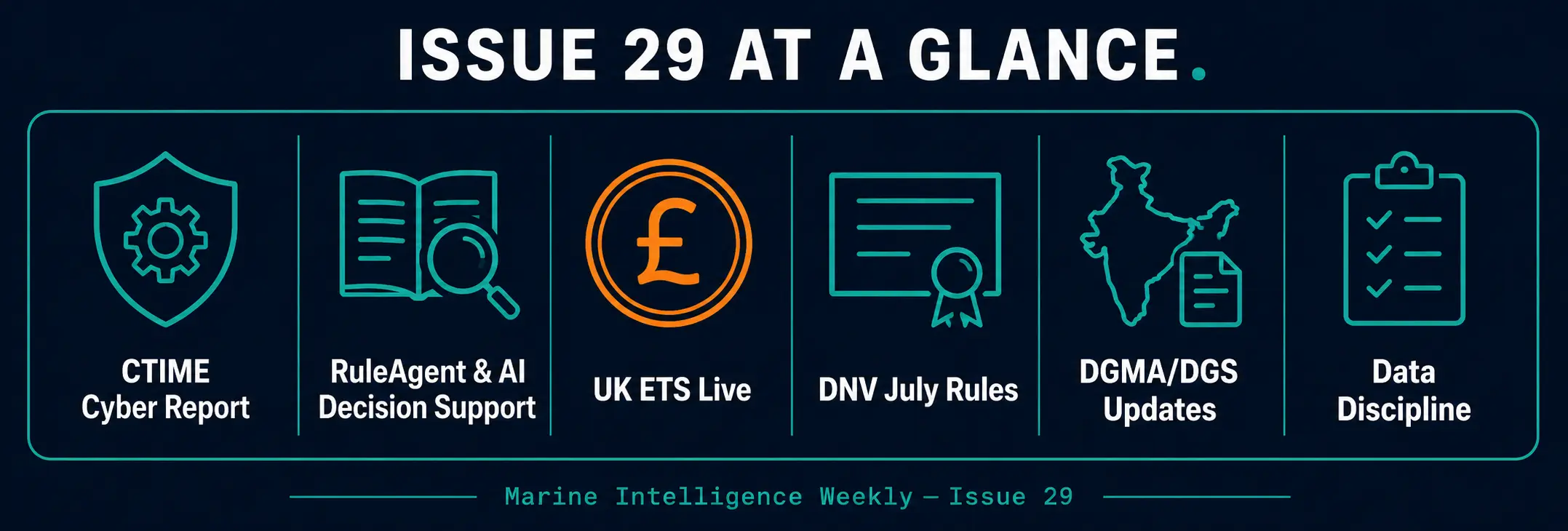
- The US Coast Guard's fifth annual CTIME report (released 8 July 2026) is this week's genuine AI/cyber signal: reported maritime cyber incidents rose 17% year-on-year, OT systems were involved in 62% of cyber missions (up from 46% in 2024), and AI-enabled cybersecurity tools showed mixed effectiveness tied to how well they're configured.
- AI adoption continues to concentrate on practical decision support through tools such as DNV's RuleAgent (launched March 2026), the Orca AI–NorthStandard fleet safety study (52% reduction in high-severity close encounters across 139 vessels), predictive machinery-health analytics, and voyage optimisation — normal fleet tools now, not experimental extras.
- Carbon pricing pressure is now live in practice, with the UK ETS applying to shipping from 1 July 2026 for cargo and passenger ships of 5,000 GT and above.
- DNV's July 2026 rules edition is the key class development of the week, with new notations and fuel-related rule changes entering into force on 1 January 2027.
- DGMA/DGS has issued a meaningful set of India-relevant orders and circulars in recent weeks, including Hong Kong Convention implementation, revised CDC eligibility criteria, Gulf-region security precautions, and a seafarer wellness circular.
- For engineers, the practical message is straightforward: cleaner data, tighter logs, cyber-safe integration, and early class review of retrofits now matter as much as mechanical reliability.
Feature Article
AI Is No Longer the Headline. It Is Becoming Part of the Watch.
This week's clearest AI signal isn't a new launch — it's a cybersecurity report. The USCG's fifth annual CTIME report (8 July 2026) found maritime cyber incidents up 17% year-on-year, OT involved in 62% of cyber missions (up from 46% in 2024), and AI-enabled cyber defences delivering mixed results depending on configuration, not the tool itself. The lesson: AI doesn't substitute for the fundamentals — secure systems, MFA, incident reporting, continuity planning.
Two older stories still anchor the wider decision-support trend: DNV's RuleAgent (March 2026), natural-language rule retrieval rather than decision-making, and Orca AI–NorthStandard's fleet study (March–April 2026), a 52% reduction in high-severity close encounters across 139 vessels — still the strongest fleet-scale safety evidence available. The thread through all three is data quality: predictive-maintenance and voyage-optimisation tools are only as good as the vibration trends, defect logs, and noon-report accuracy feeding them, and any AI system should be assessed like any other safety-relevant change — access control, fallback, manual override — before the result is trusted.
IMO & Regulatory Watch
Standing 2026 Amendments Are Still Doing the Real Work
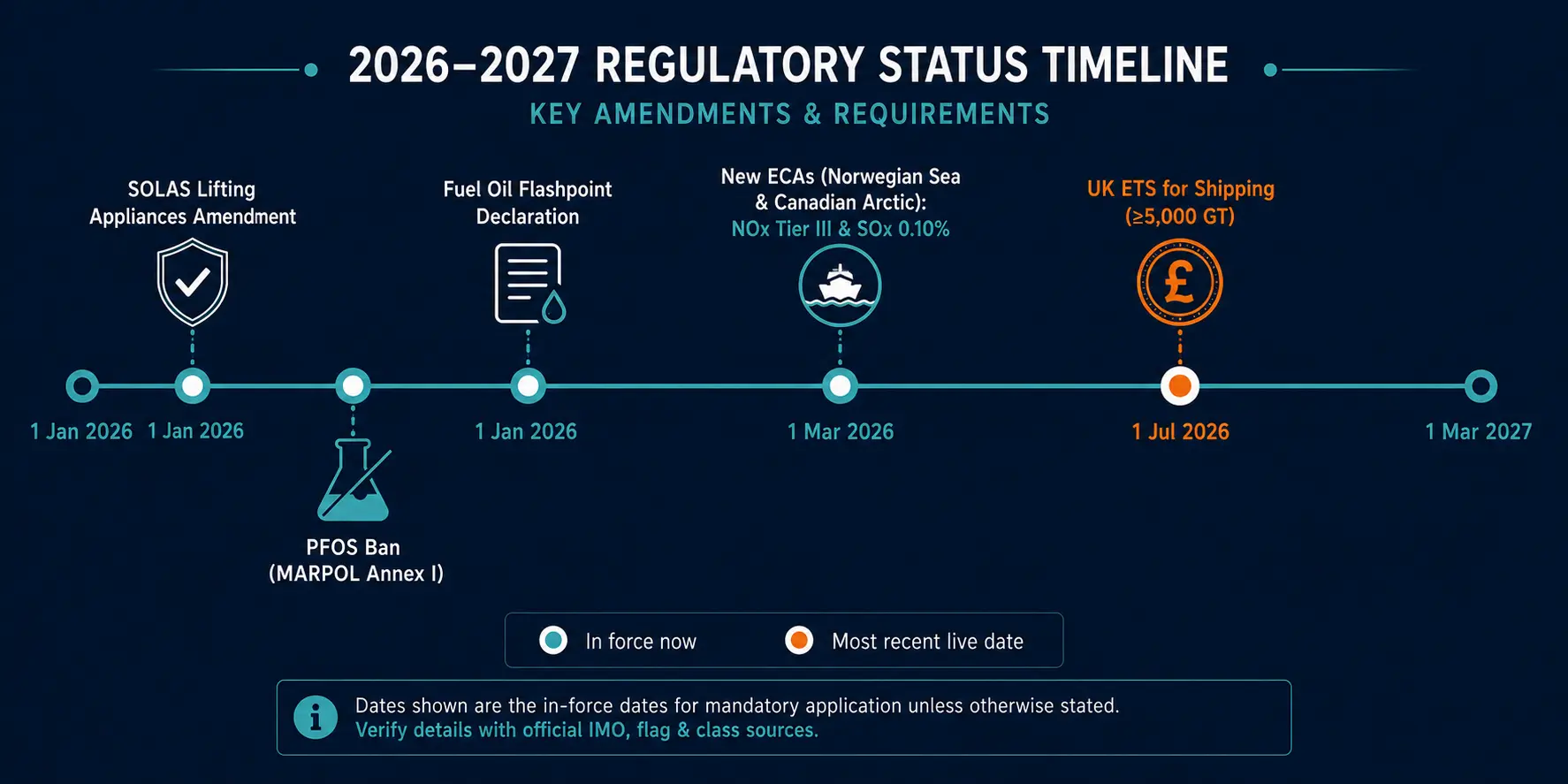
There were no major new IMO press briefings in the last seven days that changed the compliance picture in the way last week's MASS Code story did. The more important reality for shipboard professionals is that several 2026 amendments already in force are now the items most likely to appear at survey, in company audits, and in oral examination questions.
| Regulation / Instrument | What Matters Onboard | Status |
|---|---|---|
| MARPOL Annex VI new ECAs (Norwegian Sea and Canadian Arctic) | NOx Tier III applies for relevant new-build engines; SOx 0.10% m/m fuel sulphur cap follows from 1 March 2027. | In force from 1 March 2026. |
| SOLAS II-1/3-13 | Permanently installed lifting appliances and anchor handling winches require compliant design, testing, marking, examination, and documentation. | Mandatory from 1 January 2026 for new installations; existing gear at first renewal survey after that date. |
| PFOS fire-fighting media ban | Existing ships must remove PFOS-containing media by the first survey after 1 January 2026; related fire-detection upgrades affect certain ro-ro and vehicle spaces. | In force. |
| SOLAS fuel flashpoint declaration amendments | BDNs must show measured flashpoint or declaration of compliant flashpoint; bunkering verification becomes more documentation-driven. | In force. |
| UK ETS for shipping | Cargo and passenger ships of 5,000 GT and above are now exposed to UK-linked carbon-cost compliance from 1 July 2026. | Live. |
A further regulatory pressure line remains the IMO Net-Zero Framework. Current reporting compiled this week indicates that even without final global adoption yet completed, the framework is already shaping expectations around well-to-wake fuel intensity, pricing mechanisms, and future fleet technical choices. For engineers, that means flexible compliance systems and fuel-data quality matter now, even before the final legal architecture is complete.
AI in Maritime
1. Rules Intelligence: DNV's RuleAgent
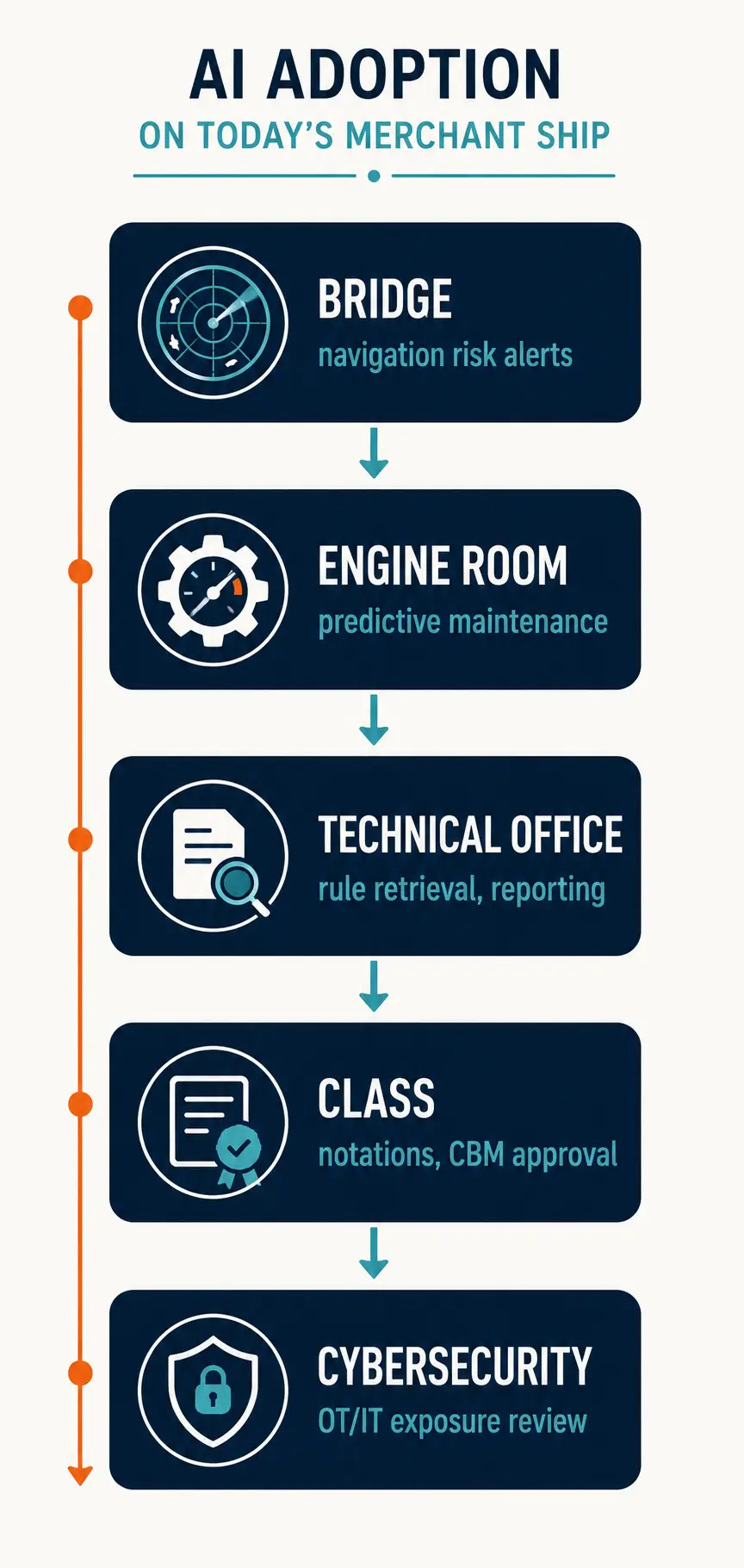
DNV launched RuleAgent in March 2026 as an AI-powered tool for navigating maritime rules and standards more quickly and with source traceability. For marine professionals, that matters because the rules burden is growing faster than most crews' available reading time. A tool like this does not replace formal class interpretation, but it can shorten the path from question to relevant clause and reduce preventable errors caused by missed wording.
2. Navigation Safety: Fleet-Scale Evidence, Not Just Pilot Language
This week's stronger AI safety signal is the reported 52% reduction in high-severity close encounters across 139 vessels using Orca AI data with NorthStandard over a 12-month period. Unlike a single trial, this is being presented as a fleet-scale operational outcome. That does not make the technology self-proving, but it does move the discussion from possibility to measurable performance.
3. Engine Room Relevance: Predictive Analytics Become Normal
Reporting from this week continues to show AI adoption focused on predictive performance analytics, machinery-health support, fuel-efficiency optimisation, and emissions management. That makes the engineer's role central: poor sensors, missing trends, inconsistent defect reports, or casual alarm handling can quietly destroy the value of otherwise advanced tools.
4. Cybersecurity: The USCG's CTIME Report Is This Week's Real Signal
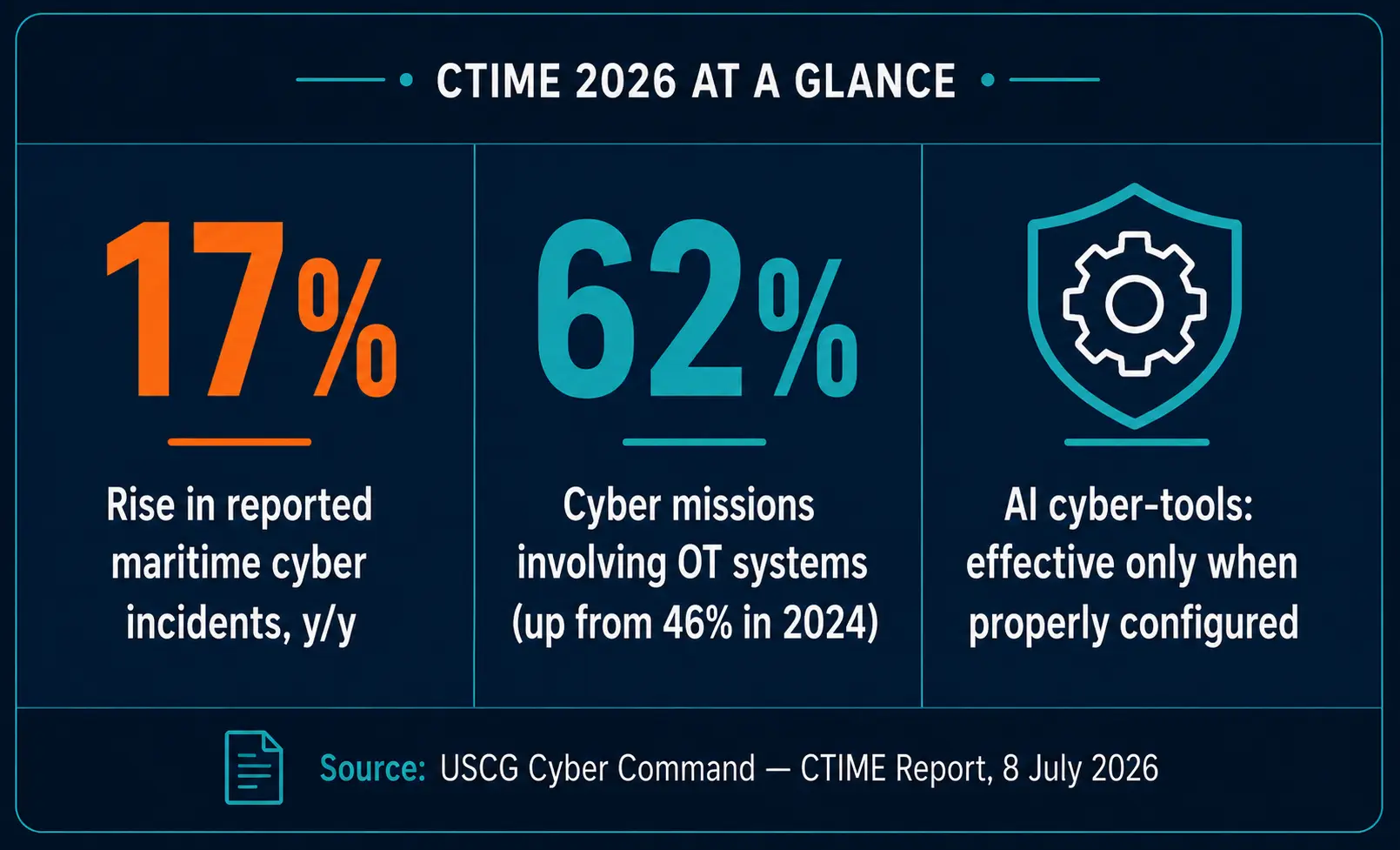
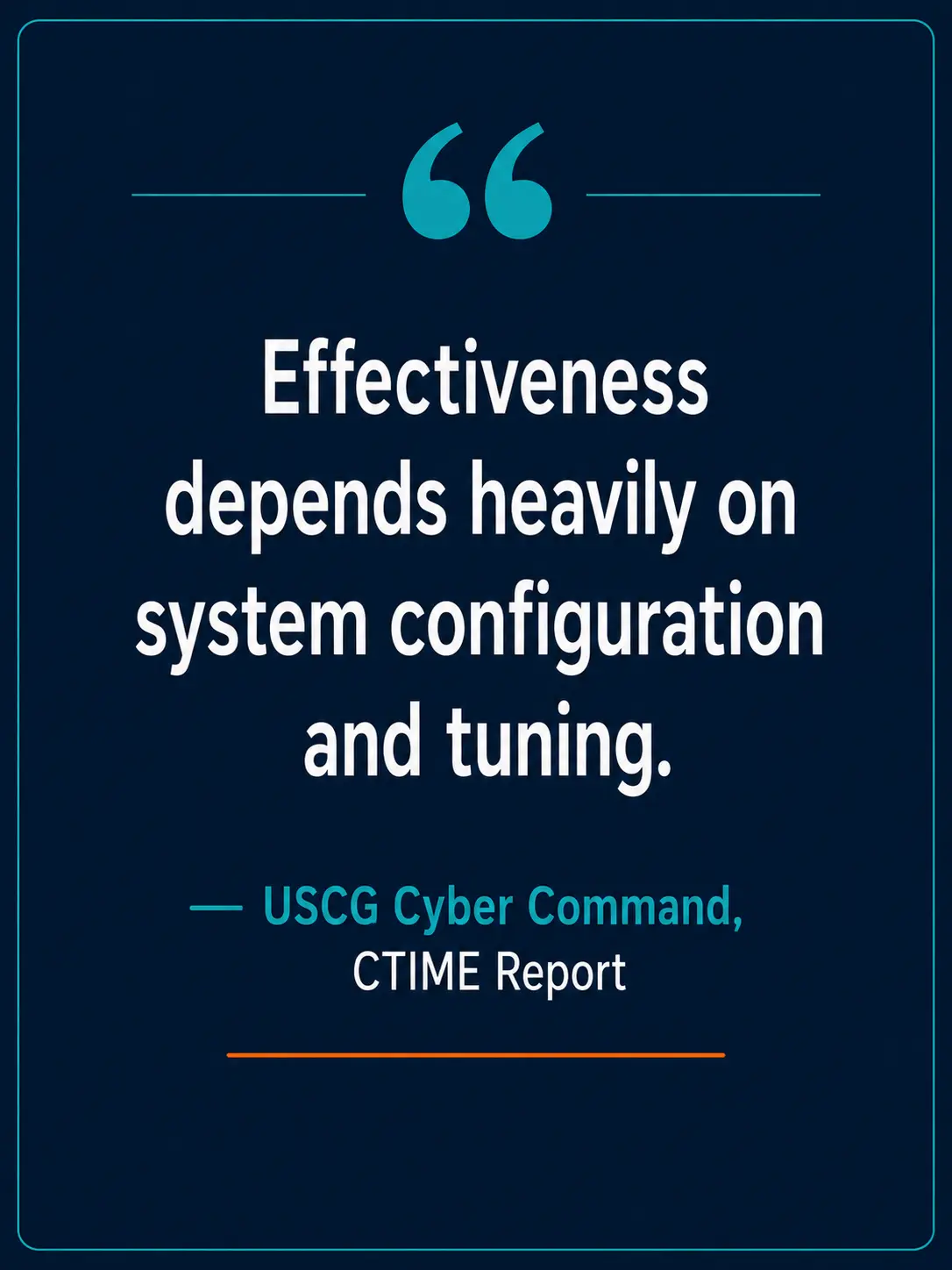
The US Coast Guard Cyber Command released its fifth annual Cyber Trends and Insights in the Marine Environment (CTIME) report on 8 July 2026, drawing on 2025 operational data. Reported maritime cyber incidents rose 17% year-on-year, phishing remained the primary entry point, and operational technology (OT) featured in 62% of cyber missions, up from 46% in 2024. The report's most useful line for engineers: AI integration with cybersecurity defences produced varied results in 2025, with effectiveness depending heavily on system configuration and tuning — not on the presence of AI itself.
What IMO and class are actually saying: Cyber risk has been a mandatory SMS item since 1 January 2021 under IMO Resolution MSC.428(98). The current working guidance is MSC-FAL.1/Circ.3/Rev.3 (4 April 2025), which realigned IMO's cyber framework to the NIST Cybersecurity Framework 2.0 by adding a Govern function alongside the existing Identify–Protect–Detect–Respond–Recover cycle — in practice, this means a named, signed-off cyber policy with assigned shipboard and shoreside roles, not a cyber programme left inside the IT department. Separately, IMO's Facilitation Committee (FAL 50, 23–27 March 2026) approved a Strategy on Maritime Digitalization and adopted mandatory cybersecurity measures for maritime single windows under the FAL Convention — a shore-side signal that digitalisation and cyber governance are now being tied together at IMO level, not treated as separate tracks.
Source: IMO
On the class side, IACS Unified Requirements E26 (ship-level cyber resilience) and E27 (resilience of onboard systems and equipment) are mandatory for newbuilds contracted from 1 July 2024 — design-stage requirements, not retrofit guidance. ABS has gone further for existing tonnage, offering a Cyber Resilience (CR) notation under its January 2026 Marine Vessel Rules, plus optional CS-1, CS-2, and CR-Ex notations depending on how far a vessel's cyber controls have been implemented and evidenced. DNV's own guidance sits alongside this same shift.
Sources: IACS, ABS, DNV
DNV's maritime cyber-security guidance reinforces the same point from the class-society side: digitalisation and AI can improve operations while increasing cyber-exposure where systems are interconnected. This is especially important on vessels where navigation, cargo, machinery, and corporate data pathways are increasingly linked. For engineers, superintendents, and IT/OT managers alike, AI adoption should trigger the same kind of sceptical review applied to any automation upgrade: what happens if the data feed is wrong, delayed, spoofed, or unavailable?
Classification Insights
DNV: July 2026 Rules Edition
DNV's July 2026 rules edition introduces new class notations, revised fatigue-related qualifiers, and a restructured DNV-OS-A101 with expanded support for other fuels, with entry into force on 1 January 2027 unless applied earlier by agreement. This is the clearest class-society change of the week because it affects how future retrofits, fuel-system changes, and machinery-adjacent modifications will be reviewed.
ABS: SMART Monitoring and Condition-Based Maintenance
ABS reported that GasLog received combined SMART (MHM) and PMP-CBM notations, signalling stronger class acceptance of continuous machinery-health monitoring and predictive maintenance methods. For engineers, that supports a broader shift away from relying only on fixed overhaul intervals and toward evidence-based machinery management.
ABS: Automation and Remote Operations
ABS also announced a conditional unmanned-bridge agreement involving Polaris Shipping, HHI, and AVIKUS, indicating continued class engagement with automation and remote-operation architectures. Even on conventional merchant ships, the operational lesson is immediate: more automation means greater dependence on network resilience, alarm integrity, and tested fallback modes.
- Review whether any DNV-classed retrofit or fuel conversion will cross into the July 2026 rule set before 1 January 2027.
- Tighten machinery-trending routines for vibration, bearing temperature, lube-oil condition, and critical auxiliaries where CBM is being pursued.
- Treat control-network changes and software additions as class-relevant reliability risks, not just IT housekeeping.
The India Angle
DGMA / DGS: Orders and Circulars Worth Watching
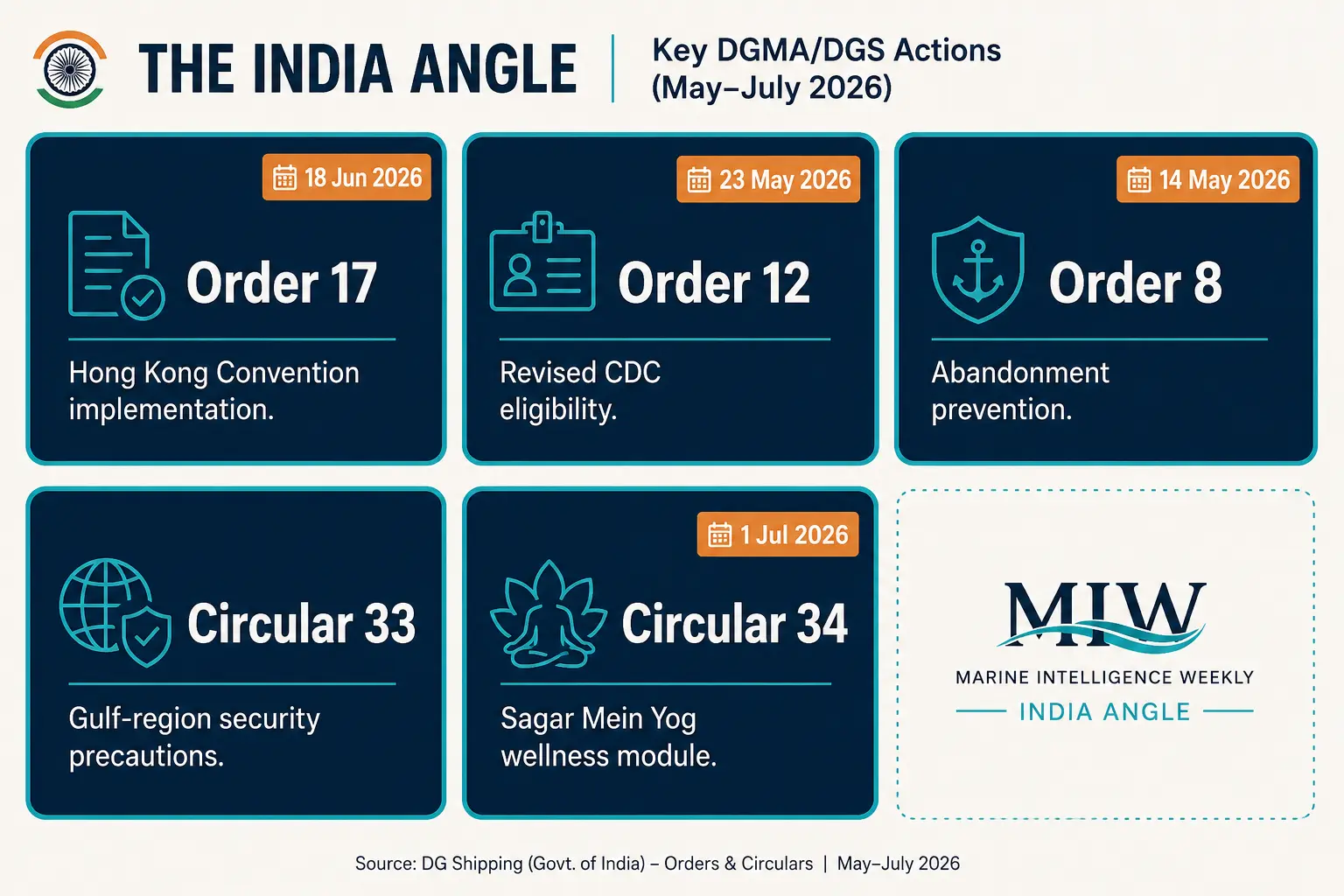
Five DGS releases issued over the past two months directly affect Indian seafarers, ship managers, and training institutions — and any fleet manager or crewing department with Indian nationals aboard, given India's share of global seafarer supply.
1. DGS Order 17 of 2026 — Hong Kong Convention Implementation
The order, dated 18 June 2026, addresses implementation of the Hong Kong International Convention for the Safe and Environmentally Sound Recycling of Ships, 2009, on Indian-flag vessels and also covers type approval and certification of ship-recycling equipment manufactured in India. This matters not only for end-of-life planning but also for documentation culture onboard, especially where IHM maintenance and recycling-preparedness records are concerned.
2. DGS Order 12 of 2026 — Revised CDC Eligibility Criteria
Issued on 23 May 2026, this order revises eligibility criteria for issue of the Continuous Discharge Certificate and seeks to improve seafarer quality standards. While administrative on the surface, it is practically important for junior engineers and ratings moving through documentation pathways.
3. DGS Order 8 of 2026 — Prevention of Abandonment of Indian Seafarers
Issued on 14 May 2026, this order sets preventive measures aimed at reducing abandonment of Indian seafarers engaged on foreign-flag vessels. This is relevant to maritime professionals well beyond crewing departments because abandonment risk intersects with welfare, wage security, MLC exposure, and company due diligence.
4. DGS Circular 33 of 2026 — Gulf-Region Precautions
Listed in the recent circulars, this circular addresses precautionary measures for Indian seafarers operating in the Gulf region. The operational point is simple: any Gulf transit should be treated as a security-and-welfare briefing issue, not only a navigational one.
5. DGS Circular 34 of 2026 — "Sagar Mein Yog" Wellness Module
Issued on 1 July 2026, Circular 34 mandates implementation of a wellness module through the maritime Learning Management System. This may appear soft compared with technical orders, but fatigue, stress, and mental resilience have direct consequences for watchkeeping quality, error rate, and retention.
- If the vessel is nearing disposal, verify IHM status and confirm awareness of Hong Kong Convention implementation requirements under DGS Order 17/2026.
- If joining, renewing documents, or mentoring juniors, check CDC-related eligibility changes under DGS Order 12/2026 rather than relying on older assumptions.
- For Gulf voyages, ensure the latest security precautions are reflected in onboard briefings and SMS practice.
Engineer's Voice

The strongest practical theme from the week's material is that the modern marine engineer is being asked to manage three systems at once: machinery, compliance, and data. Ten years ago, those could still be treated as partly separate jobs. That separation is breaking down.
A vibration trend now matters not only because it may indicate bearing wear, but because it may feed a class-backed CBM decision or a shore-side AI model. A fuel log now matters not only because it supports consumption tracking, but because it may underpin UK ETS, FuelEU, and future IMO carbon-compliance exposure. A software or network change now matters not only because it affects convenience, but because it may alter the cyber-resilience of machinery and navigation systems.
That can feel like administrative overload, but there is a better way to read it. The engineer's traditional strengths — disciplined rounds, reliable records, scepticism about instrumentation, and respect for failure modes — are becoming more valuable, not less, in a digital fleet. The future is not replacing engineering judgment with AI. It is making engineering judgment the filter through which AI either becomes useful or becomes dangerous. Engineering judgement is becoming the quality-control system for every digital tool brought onboard.
Practical Takeaway
| Topic | Key Point | Action for Engineers |
|---|---|---|
| Maritime AI | AI adoption is concentrating in decision support, not crew replacement. | Validate AI outputs against real readings and keep human fallback intact. |
| Rule navigation | DNV RuleAgent (launched March 2026) shows how AI is entering technical documentation workflows. | Use it to find clauses faster, but verify against source text before acting. |
| Carbon pricing | UK ETS is now live for shipping from 1 July 2026. | Tighten bunker records, fuel logs, and voyage-emissions data quality. |
| Class changes | DNV's July 2026 rules enter into force on 1 January 2027. | Screen retrofits and fuel-system changes now for rule impact. |
| Machinery monitoring | ABS developments confirm momentum toward CBM and health monitoring. | Improve trending discipline for vibration, LO condition, temperatures, and alarms. |
| India regulatory watch | DGS Orders 17/2026, 12/2026, 8/2026 and Circulars 33/34 of 2026 are immediately relevant. | Review IHM/recycling status, CDC assumptions, Gulf precautions, and wellness compliance. |
| Cybersecurity | USCG CTIME (8 July 2026): incidents up 17% y/y, OT in 62% of missions; AI cyber-tools only as good as their configuration. | Confirm access control, fallback mode, and manual override before trusting new AI-enabled tools. |
The industry's AI race is no longer about autonomy — it's about trustworthy data, disciplined engineering, and cyber-resilient decision support.
Sources
Government
- US Coast Guard Cyber Command — CTIME Report (5th annual, released 8 July 2026), summarised via SAFETY4SEA: safety4sea.com
Primary Sources — IMO
- IMO — Maritime cyber risk / MSC-FAL.1/Circ.3/Rev.3 (4 April 2025), Guidelines on Maritime Cyber Risk Management: imo.org
- IMO — Facilitation Committee (FAL 50, 23–27 March 2026) press briefing on the Strategy on Maritime Digitalization and cybersecurity measures: imo.org
Class & Industry
- IACS — Unified Requirements E26/E27 (Cyber Resilience of Ships / of On-Board Systems and Equipment), mandatory for newbuilds contracted from 1 July 2024: iacs.org.uk
- ABS — Maritime Cybersecurity regulatory update, Cyber Resilience (CR) notation under the January 2026 Marine Vessel Rules: eagle.org
- DNV — RuleAgent launch (March 2026): dnv.com
Research
- Orca AI / NorthStandard — joint safety study (March–April 2026): north-standard.com
CTIME source above is a trade-press summary (SAFETY4SEA) pending confirmation of a direct USCG.mil primary link. All standing regulatory, DNV July 2026 rules, ABS SMART/PMP-CBM, and DGMA/DGS citations carried over from prior sourcing — confirm all URLs are still live before this page goes public.