 MIW
MIW
Quick Read
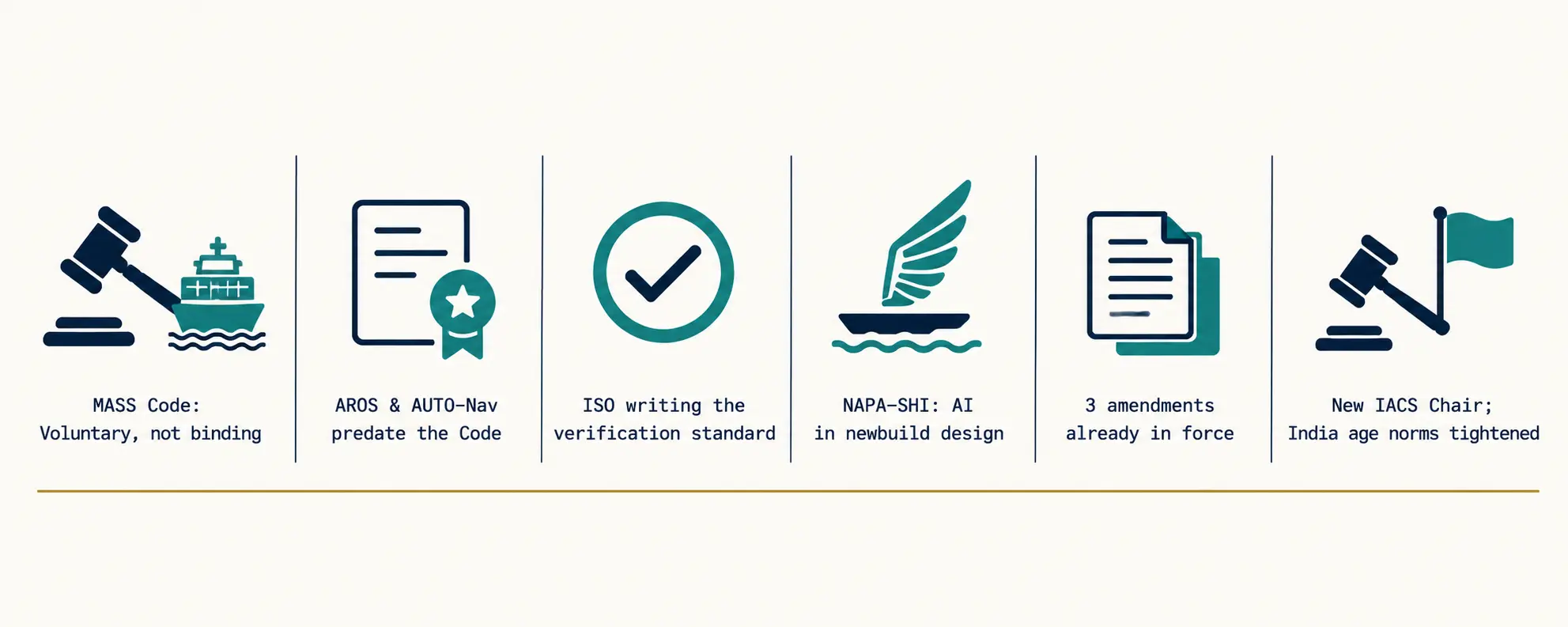
- The IMO's new MASS Code took effect 1 July 2026 — but as a voluntary, non-mandatory framework, not binding law. Mandatory status isn't expected before 2032.
- Class societies didn't wait for the Code: DNV's AROS notation (live since 1 Jan 2025) and ClassNK's AUTO-Nav (already on the commercial coastal boxship Genbu) predate it — the Code now gives those notations a shared international reference point.
- ISO/TC 8/SC 26 is concurrently drafting the verification-procedure standard that will let flag states and class societies actually test the Code's "equivalent safety" claim.
- NAPA and Samsung Heavy Industries signed an MoU pushing voyage-optimisation AI into newbuild design, tied to SHI's SAVER Wing wind-assist system.
- Three standing 1 January 2026 amendments — SOLAS fuel flashpoint, IGC/IGF high-manganese steel, IMDG 2024 — remain the parts of the regulatory picture most likely to show up at survey and in an oral this month.
- IACS has a new Council Chair as of 1 July, with Paris MoU RO-scoring methodology as a live watch item; DGS Order 01/2026 tightens age norms for Indian-flag tonnage.
Feature Article
The MASS Code Is in Force. It's Also Optional. Both Facts Matter.
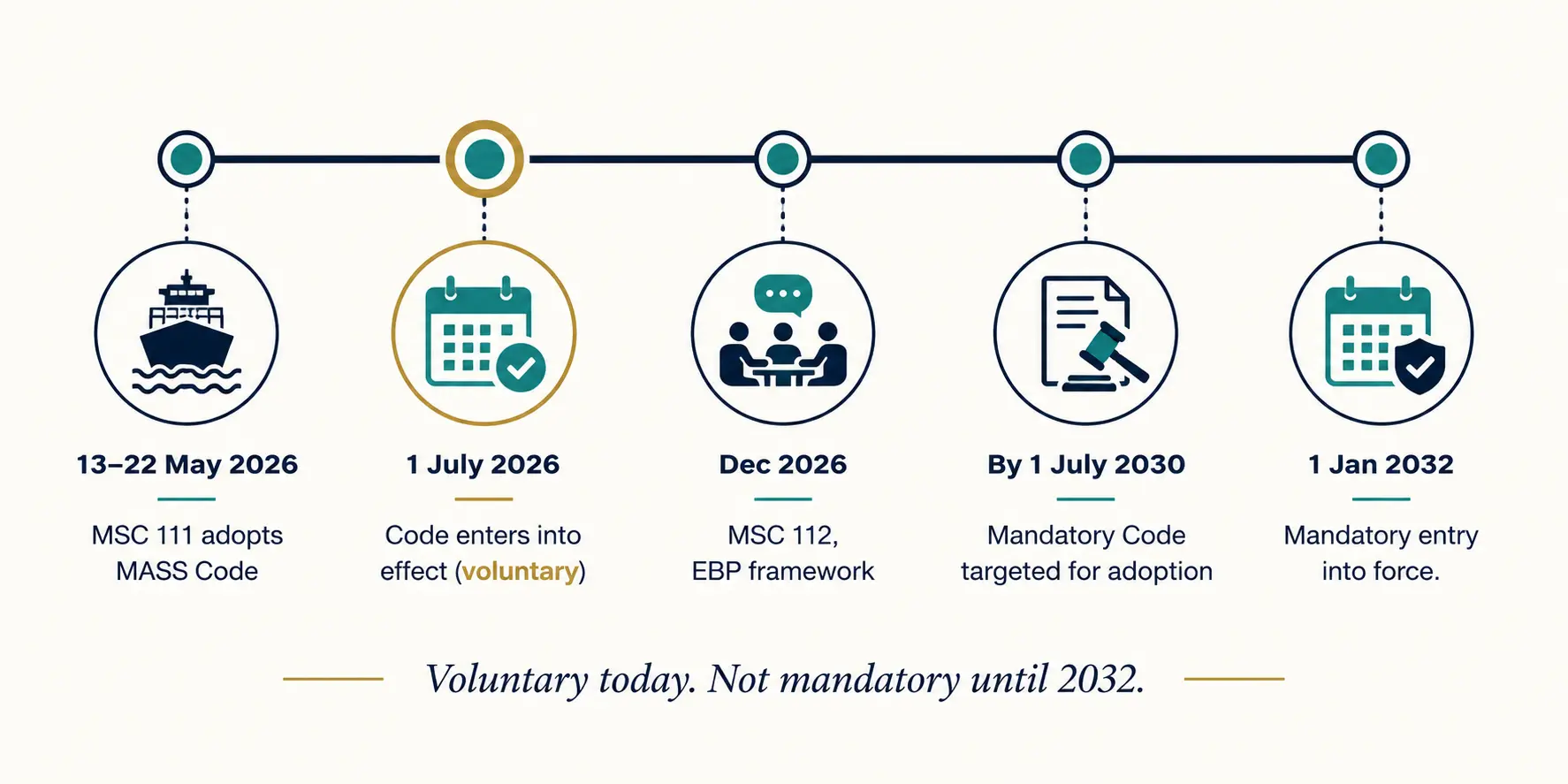
On 1 July 2026, the International Code of Safety for Maritime Autonomous Surface Ships — the MASS Code — entered into effect. It is the first global instrument that speaks directly to AI-enabled navigation and remote machinery control on cargo ships. Adopted at the IMO's 111th Maritime Safety Committee session (13–22 May 2026), it sets a goal-based standard: autonomous and remotely operated ships must be designed, built and operated to a level of safety, security and environmental protection equivalent to a conventional ship, and must still comply with SOLAS and other mandatory IMO instruments where applicable.
Here is the detail that gets lost in most of the coverage this week, and the one worth remembering for an oral: the Code is not mandatory. It applies to large, internationally trading cargo ships, and for now it runs on a voluntary basis for a minimum of two years — what the IMO calls an Experience-Building Phase. Flag states and operators who choose to use it will generate the operational data, remote-operations logs and design-verification experience the IMO says it needs before it drafts a mandatory version, expected for adoption by 2030 and entry into force on 1 January 2032, via a new SOLAS chapter.
For a Second Engineer today, the Code's practical reach is still narrow — most of us aren't sailing on Degree 3 or 4 tonnage. But the framework matters for three reasons that will show up faster than the mandatory timeline suggests.
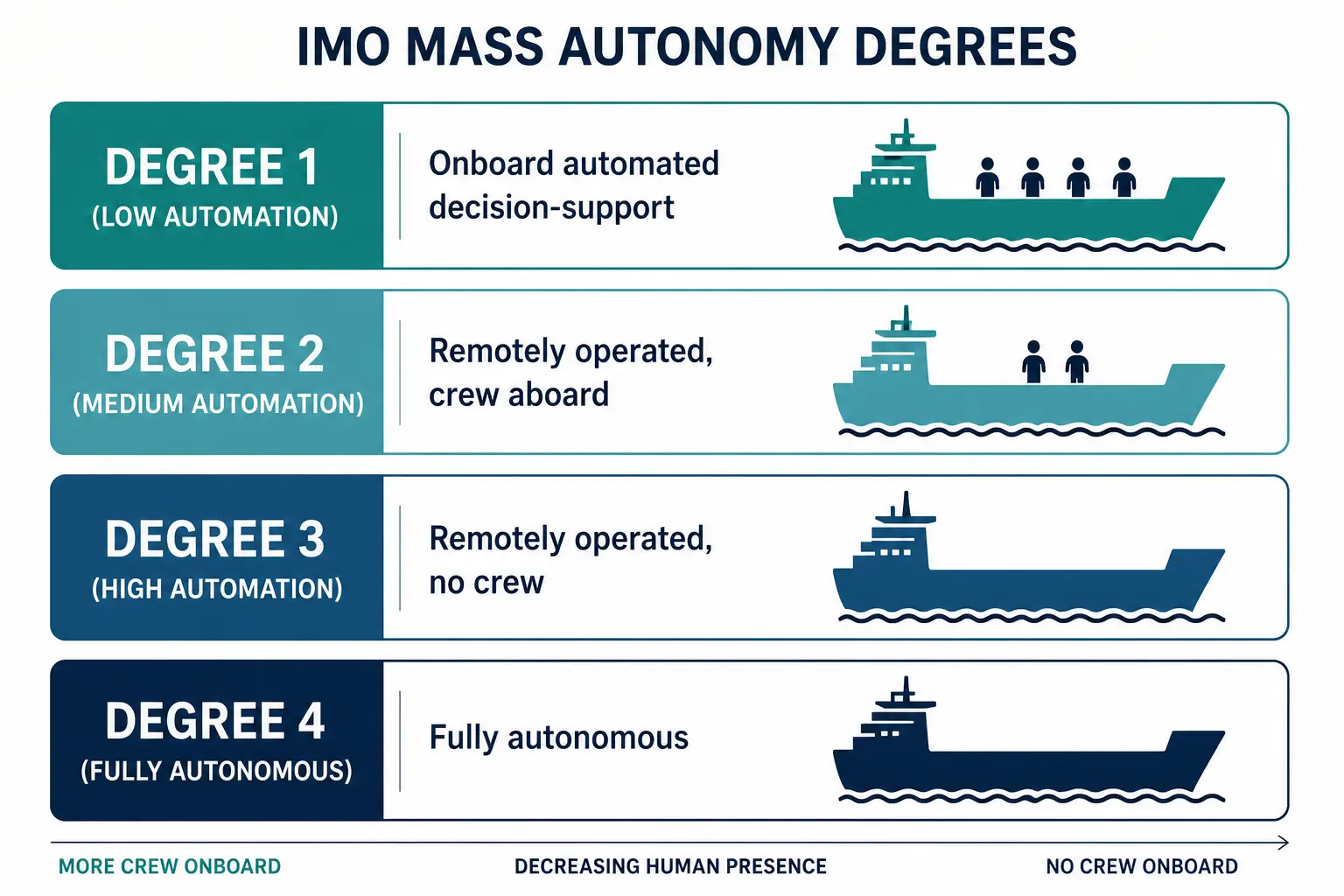
First, it defines the vocabulary classification societies already use. The Code recognises four degrees of autonomy — from onboard automated decision-support (Degree 1) through remote operation with crew aboard (Degree 2), remote operation with no crew (Degree 3), to full autonomy (Degree 4). Class societies didn't wait for the Code to build notations around this scale: DNV's AROS family has been live since 1 January 2025 and is explicitly aligned with these degrees, and ClassNK's AUTO-Nav2(All) notation is already carried by Genbu, a domestic Japanese coastal containership — not a trial craft, a commercially operating one. What the MASS Code adds is not the notation concept itself, but a shared international reference point those notations can now point back to. If you're involved in vetting a newbuild spec in the next few years, know what degree of autonomy — and which class notation — you're actually buying.
Source: DNV, ClassNK
Second, "equivalence" is the load-bearing word in the whole Code, and it's no longer just a principle — it's becoming a testable one. ISO's Technical Committee 8, Subcommittee 26, registered a Committee Draft (ISO/CD 25934) in April 2026, setting out verification procedures for autonomous navigation systems. Put simply: the MASS Code sets the safety goal ("equivalent to a conventional ship"); ISO/CD 25934 is the emerging technical method for actually proving a system meets it. That's a genuinely useful frame for engine-room automation generally, autonomous or not — if a remote diagnostic system can't demonstrably substitute for a watchkeeper's judgement under a recognised verification method, it hasn't met the bar the IMO just wrote down.
Source: ISO
Third, passenger ships are explicitly left out — for now. The IMO deferred extending the Code to passenger vessels, citing the added complexity of safety and liability with people aboard who aren't crew. That's a pragmatic sequencing decision, but it also tells you where the harder regulatory argument is still to come.
None of this changes what happens on your watch tomorrow. What it does is start the clock on a decade-long shift in how "safe" gets defined and demonstrated for the more automated end of the fleet — and gives you, right now, the correct one-line answer if an examiner asks whether the MASS Code is binding: not yet, and not until at least 2032.
Regulatory Pulse
Standing 1 January 2026 Amendments Still Do the Daily Work
While the MASS Code carries this week's headline, three amendments already in force since 1 January 2026 are the ones more likely to affect your paperwork and your next survey.
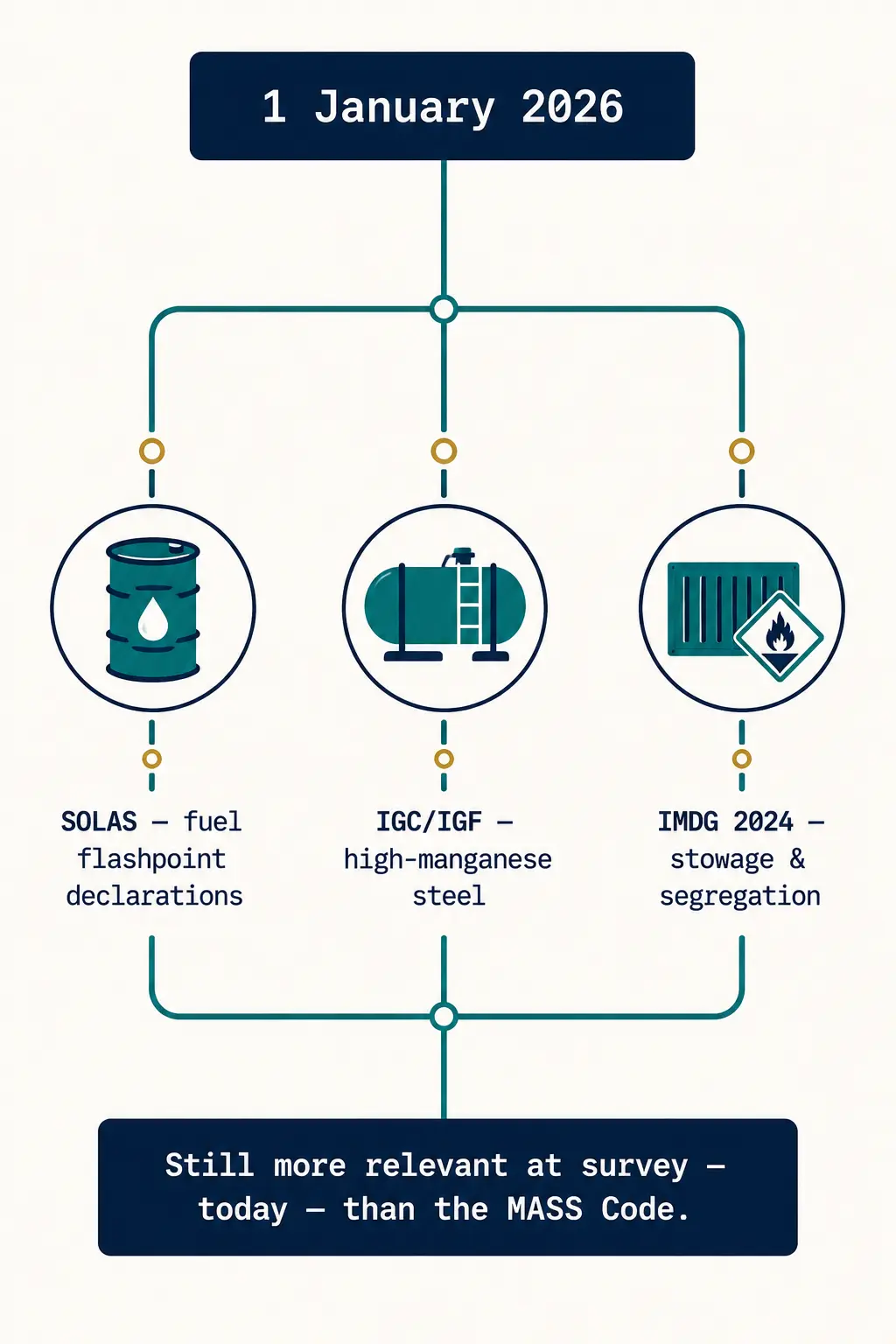
SOLAS — Fuel Flashpoint
Strengthened requirements to prevent supply of non-compliant fuel, including mandatory supplier declarations before bunkering.
IGC/IGF — High-Mn Steel
High-manganese austenitic steel now permitted for cryogenic service in LNG cargo and fuel tanks.
IMDG Code 2024 Edition
Updated stowage, segregation and engineering-interface requirements for dangerous goods.
SOLAS II-1/3-13 — Lifting Appliances
Continues to govern design, construction, testing and maintenance of deck cranes and permanently installed lifting gear.
The Technical Anchor: ISO Is Writing the Verification Standard Behind "Equivalence"
ISO/TC 8/SC 26 registered ISO/CD 25934 in April 2026 — Committee Draft stage, consultation open — to define structured verification procedures for autonomous navigation systems on MASS. It sits alongside the existing ISO/TS 23860, which defines the vocabulary (ROC, MASS, degrees of autonomy) examiners may expect you to use precisely.
Source: ISO
AI in Maritime
1. Design-Stage AI: NAPA and Samsung Heavy Industries Bring Voyage Optimisation Into the Drawing Office
NAPA and Samsung Heavy Industries (SHI) signed a Memorandum of Understanding on 30 June 2026 that pushes AI-driven efficiency upstream into newbuild design, centred on SHI's SAVER Wing — a rigid, two-element wing-sail wind-assist system. The partnership will model SAVER Wing-equipped vessel designs against real operating data and trading routes rather than generic design assumptions, so owners see projected fuel and emissions outcomes before committing to a hull form and propulsion package.
The MoU builds on a joint pilot project the two companies launched in May 2026, and now extends to embedding NAPA Voyage Optimization inside SHI's Samsung Autonomous Ship (SAS) platform, plus using NAPA's Operational Simulation tools to build digital twins of ship equipment from the design stage onward.
Source: NAPA
2. Back-Office AI: Fleetwork's Cloud ERP Moves Beyond Pilots
Fleetwork's cloud-native ERP and "AI FleetVision" assistant now run across more than 100 vessels operated by 11 shipping companies, with around 300 active users two years after launch — reporting-preparation time reportedly cut by up to 90% for early adopters.
These figures are vendor-reported (Posidonia 2026 exhibitor material), not independently audited — treated here as an industry signal, not a proven benchmark. For ship managers, the more durable signal is where the risk-adjusted returns on AI currently sit: back-office workflow and documentation, not autonomous navigation.
3. Port AI: China Merchants Port's Smart Logistics Suite
CMPort is reported to be rolling out a "Smart Logistics Suite" pulling berth planning, crane scheduling, yard allocation and truck appointments into one AI-driven layer, as part of Beijing's 2026–2030 smart-port push. (Sourced to trade press only — treat specific dwell-time figures as reported, not confirmed.)
4. Second-Order Effect: Data Centres and Shipyards Are Drawing on the Same Engine Supply
Industry reports suggest AI data-centre buildouts (1–4 MW backup generator demand) overlap with the marine and industrial engine manufacturing base shipyards depend on, with some yards reporting tighter engine availability and firming prices. (Trade-press sourced only — kept here as a supply-chain signal, not a confirmed industry-wide trend.)
Classification Insights
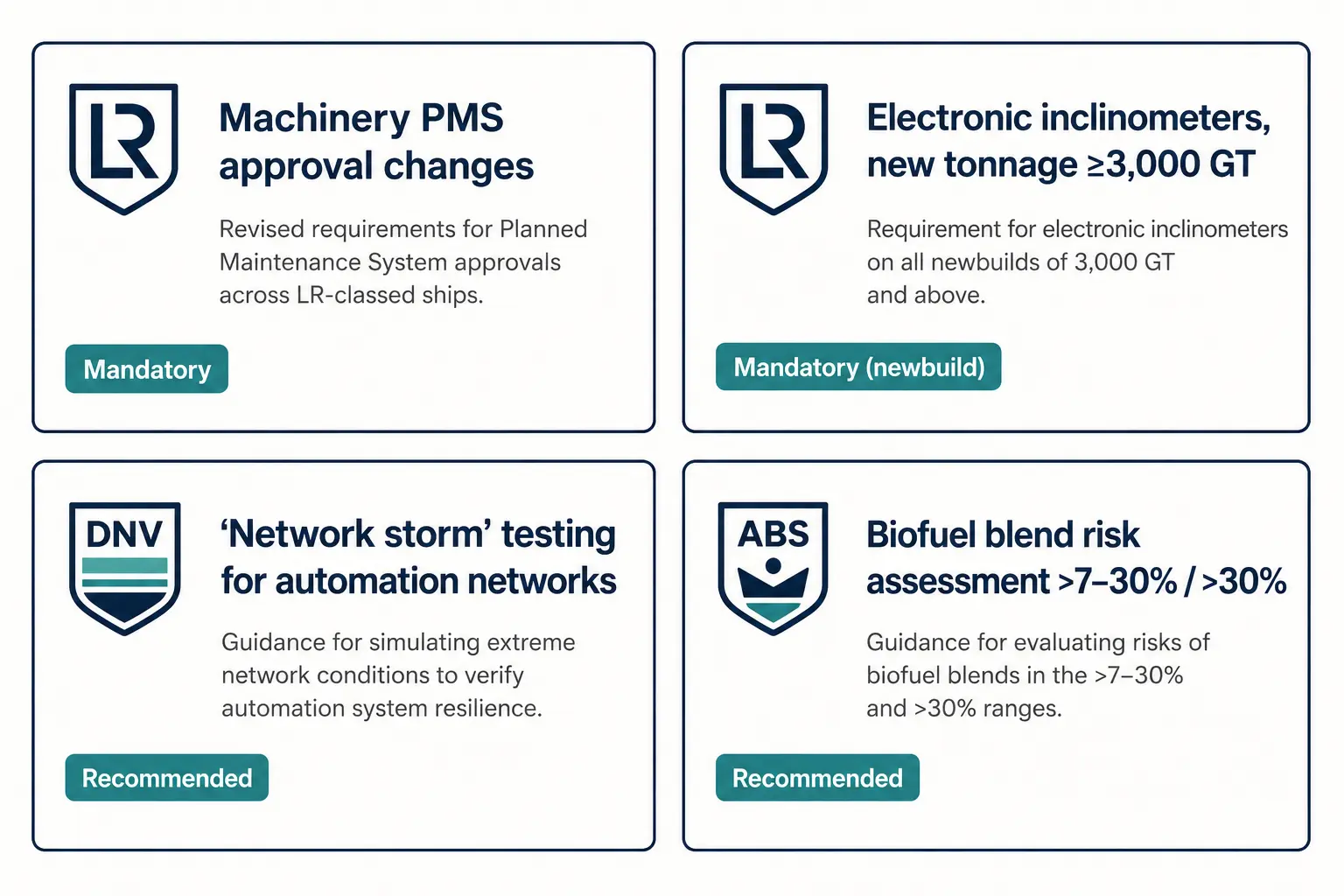
For engineers, the LR PMS update and ABS biofuels guidance will most visibly change everyday practice — they affect how machinery reliability, maintenance records and fuel handling are accepted at survey. DNV's network-storm guidance is especially relevant on highly automated vessels, pointing at a real failure mode: overloaded control networks silently degrading redundancy and alarm visibility.
- Confirm your LR-approved PMS documentation and intervals match the latest class wording before survey attendance.
- On newbuilds, ensure electronic inclinometer installations meet LR/IMO requirements and treat heel/trim data as safety-critical.
- On DNV-classed ships with integrated automation, include network-storm and redundancy testing after software changes or network expansion.
- For biofuel blends, verify OEM compatibility, monitor separator/filter performance, and revisit elastomer and seal materials before long-term use.
Also This Week: Leadership Change at IACS, and Autonomy Notations Already Earning Freight
IACS Council Chair transition (effective 1 July 2026): Alex Gregg-Smith, President Marine & Offshore at Bureau Veritas, took over as IACS Council Chair. A key watch item from his term's opening priorities: IACS's position on proposed changes to the Paris MoU's Recognised Organisation (RO) scoring methodology, which the Council wants kept transparent and proportionate — this feeds into how PSC performance is weighted against your class society's record.
Source: IACS
ClassNK and Orca AI — Degree 2 autonomy already earning a freight rate: ClassNK's AUTO-Nav2(All) notation is now carried by Genbu, a domestic Japanese coastal containership — the first such notation on a vessel in genuine commercial service, not a trial. Separately, Lloyd's Register completed a structured live-vessel trial of Orca AI's computer-vision navigation platform, using precision/recall metrics plus crew human-factors feedback; Orca AI reports over 1,200 vessels running its system fleet-wide. Between the two, Degree 2 autonomy is no longer a future concept for a Class 1 oral — it's a documented, commercially operating class of vessel today.
Sources: ClassNK, Lloyd's Register
The India Angle
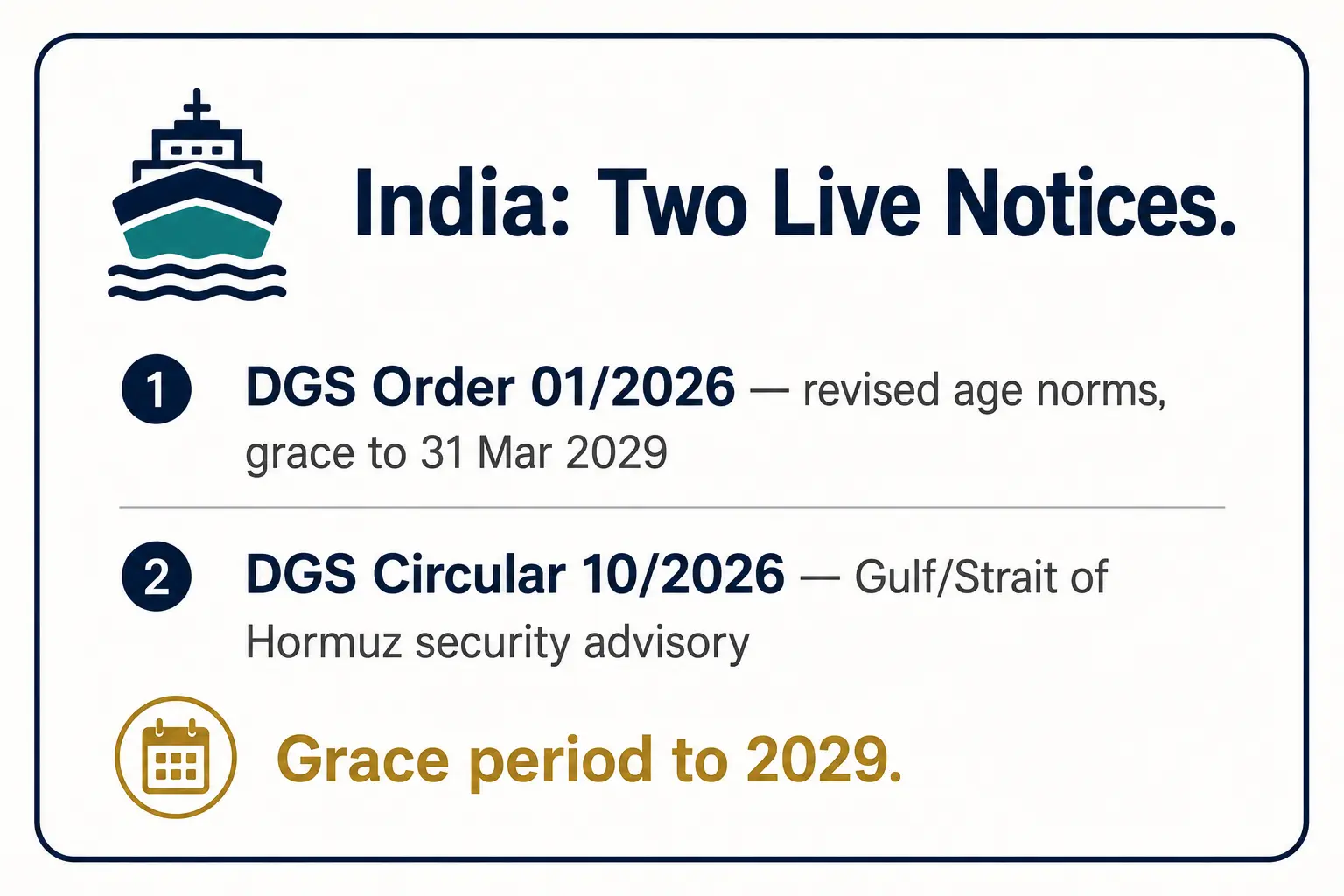
1. DGS Order 01 of 2026 — Revised Fleet Age Norms
DG Shipping (transitioning to DGMA — Directorate General of Maritime Administration, under the Merchant Shipping Act 2025) has issued revised maximum-age and qualitative parameters for Indian-flagged vessels, and for foreign-flag vessels operating under Sec 406/407 licences. Age is calculated from the delivery date on the Cargo Ship Safety Construction Certificate. Existing vessels affected can continue operating until 31 March 2029, with a possible two-year extension to 2031 pending a "Sustainability Indexing of ships" review. Passenger vessels, FSRU, FPSO and several specialised vessel types are excluded.
Source: IRClass
2. DGS Circular 10 of 2026 — Gulf/Strait of Hormuz Security Advisory
An updated safety advisory remains in effect for Indian seafarers and shipping stakeholders operating in the Persian Gulf, Strait of Hormuz and adjacent waters, calling for continuous vessel monitoring and strict adherence to company Ship Security Plans — alongside the IMO's own MSC 111 provisions for temporary STCW certificate management for seafarers affected by regional disruption.
Source: DG Shipping, IMO
Nixon's Voice

I keep coming back to one line from the SHI–NAPA announcement: "they need confidence in the efficiency data before they sign the contract." That's not really about wing sails. That's about a shipowner refusing to buy a promise anymore — they want the model run against their actual routes first.
I'd like class societies, ERP vendors and, frankly, this newsletter held to the same standard. This issue, I flagged three separate claims — Fleetwork's user numbers, CMPort's dwell-time improvement, the engine lead-time story — as vendor-reported or trade-press-only, because I couldn't independently verify them in the time I had. That's not a small caveat. The MASS Code correction is the same instinct in a different place: "voluntary framework" and "binding law" describe two very different worlds, and conflating them in an oral answer is exactly the kind of mistake that costs marks.
The pattern under all of it: AI is making it cheaper to demand proof before commitment — in ship design, in ERP procurement, in regulation itself. The Code doesn't mandate autonomy. It mandates that if you claim a ship is safe without a full crew, you now have to show your working. I think that's the right instinct, and I think it's coming for a lot more than autonomous ships.
For a Class 1 oral or viva, you can frame "current AI and regulatory developments affecting merchant ships" around:
- MASS Code entry into force as a voluntary, non-mandatory framework, and class-led autonomy notations that predate and now align to it.
- ISO's parallel verification work as the mechanism that will let "equivalent safety" actually be tested, not just claimed.
- Operational AI in design, back office and ports, and the second-order engine-supply signal, as practical impacts on scheduling and capex.
- The engineer's role in data quality and documentation — the same discipline this issue's verification notes were built on.
Test yourself on the MASS Code's dates and status — voluntary or binding, 2026 or 2032 — before reading back over this issue. That's worth more before an oral than a second read-through.
Takeaway Table
| Topic | Key Point | Action for Engineers |
|---|---|---|
| MASS Code | In force 1 July 2026, but non-mandatory — voluntary 2-year Experience-Building Phase; mandatory version not expected before 2032 | Know the distinction cold for orals; DNV AROS / ClassNK AUTO-Nav already predate the Code |
| ISO/CD 25934 | ISO/TC 8/SC 26 is drafting the verification-procedure standard behind the Code's "equivalence" requirement | Use as the answer to "how is equivalence proven?" in an oral |
| NAPA–SHI MoU | Voyage-optimisation and digital-twin modelling now pushed into newbuild design stage | On newbuild/retrofit specs, insist on route-specific simulation, not generic assumptions |
| SOLAS/IGC/IGF/IMDG (1 Jan 2026) | Fuel flashpoint declarations, high-Mn steel for cryogenic tanks, IMDG 2024 stowage rules — all already in force | Verify bunker declarations and stowage plans against current-edition requirements |
| Class updates (LR/DNV/ABS/IACS) | PMS approval changes, network-storm testing, biofuel-blend risk assessment, new IACS Chair and RO-scoring debate | Cross-check PMS pre-survey; test automation networks after changes; watch RO-scoring developments |
| India Angle | DGS Order 01/2026 age norms (grace to 2029); DGS Circular 10/2026 Gulf security advisory | Check vessel age against Annexure-I now; confirm SSP alignment before Gulf transits |
| AI-driven engine supply | Reported overlap between AI data-centre generator demand and shipyard engine sourcing | Build engine/genset lead-time risk into newbuild and retrofit project planning |
Sources
- IMO — MASS Code adoption / MSC 111 press briefing: imo.org
- Lloyd's Register — MSC 111 Summary Report: lr.org
- Lloyd's Register — Orca AI navigation trial: lr.org
- DNV — MSC 111 news / AROS notation background: dnv.com ; offshore-energy.biz
- ClassNK — AUTO-Nav2 notation to Genbu: marinelink.com
- IACS — Council Chair transition, Paris MoU RO scoring: iacs.org.uk ; marinelink.com
- ISO/TC 8/SC 26 — ISO/CD 25934 project page: iso.org
- NAPA — official MoU release: napa.fi
- IRClass — DGS Order 01/2026 (age norms) technical circular: irclass.org
- IRClass — Technical Circulars index: irclass.org
- DG Shipping / DGMA — official portal: dgma.gov.in
Fleetwork ERP figures, CMPort dwell-time claims, and the engine-lead-time squeeze story remain trade-press-sourced only (Splash247, IndexBox, Posidonia exhibitor material) — flagged throughout as vendor/trade-press signals rather than verified fact.