
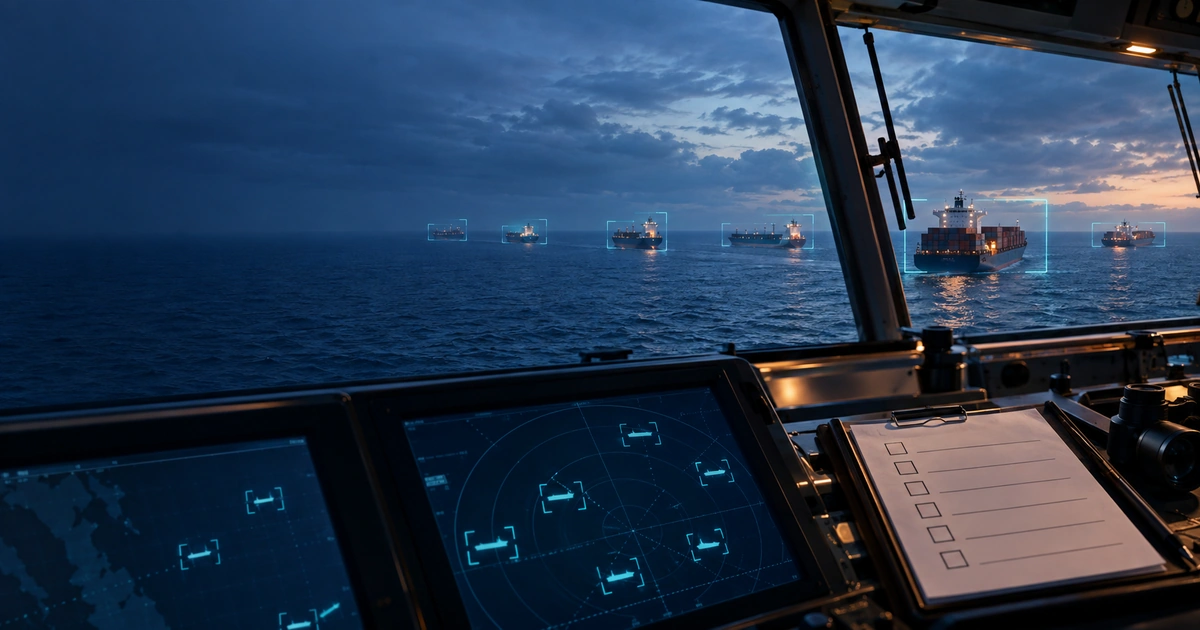
Nine sections. Read the ones you need.
This issue is one page, but you do not have to read it in order. Every section below is a separate article with its own link.
- 01AI IN MARITIMEEastern Pacific is scaling AI navigation to dozens of ships — on evidence it measured itself
- 02DIGITAL MARITIME / AUTONOMY / CYBERThe MASS Code has been in effect since 1 July. It is voluntary; a mandatory Code is targeted for 2032.
- 03REGULATORY & SAFETY INTELLIGENCEThirteen weeks from the Net-Zero vote, the working group ran out of time
- 04DECARBONISATION & FUTURE FUELSTwo EU ETS numbers that are easy to mix up — and why the harder surrender is the next one
- 05INDIA MARITIMEIndia now wants a daily position for every Indian seafarer in a high-risk area — including on ships it does not flag
- 06ENGINEER'S DESK / MEO CLASS IWhat a Chief Engineer actually has to do about this issue
- 07WATCHLISTDated forward milestones, and the items MIW is deliberately not yet publishing as fact
- 08NIXON'S VOICE / EDITOR'S SYNTHESISThe week maritime AI got bigger and no better checked
- 09WHAT DID WE LEARN TODAY?What did we learn today?
Eastern Pacific is scaling AI navigation to dozens of ships — on evidence it measured itself
A five-vessel pilot over 130,000 nautical miles cut close-encounter events by 48%, according to the operator and the vendor. No independent assessor is named, and the fleet-wide rollout decision has already been taken.
The deployment is real and running. The measurement of its benefit is the operator's and the vendor's own. Both labels are correct simultaneously and neither may be dropped.

The deployment is real and running. The measurement of its benefit is the operator's and the vendor's own.
On 25 August 2026, Orca AI announced that Eastern Pacific Shipping would extend its computer-vision navigation platform to dozens of additional vessels, after a five-ship pilot covering more than 130,000 nautical miles. According to the two companies, the pilot data showed a 48% reduction in close-encounter events per 1,000 nautical miles and a 10% increase in average minimum passing distance. On one named vessel, Pacific Sentinel, open-water close encounters fell 84% and minimum passing distance rose 50% within six months of installation.
What happened. OPERATIONALLY DEPLOYED This is a real system in real service, not an MoU. Orca AI's platform has two parts: SeaPod, a bridge unit using computer vision to detect and classify surrounding vessels and objects — including targets that carry no AIS transponder, such as fishing vessels and buoys — and FleetView, a shoreside analytics layer that lets office teams review navigational events and identify trends across the fleet. The pilot ran on five vessels. The decision announced in August moves it to dozens more. Eastern Pacific's technical director, Sachin Saharawat, said the pilot "gave us objective data on how navigational risk changed over time."
What the evidence actually is. VENDOR-REPORTED The announcement names no independent assessor, no class society, and no third-party verification body. The measurements were produced by Eastern Pacific and Orca AI from the platform's own operational data. That does not make them wrong. It makes them a particular kind of claim, and the kind matters here more than usual, because of what is being measured.
A close-encounter event is not a fact like a fuel flow reading. It is a defined event — somebody has to decide what counts as one, at what distance, at what closing rate, in what traffic density. Change the definition and the percentage changes with it. When the system that detects the events is also the system being evaluated, and the definition lives inside that system, the measurement and the product are not fully independent of each other. A 48% reduction could reflect a genuine and substantial improvement in navigational safety. It could also partly reflect a baseline drawn from a period when nobody was counting as carefully. From outside, with no published methodology, a reader cannot separate the two.
The rollout decision has been made. As of 4 October 2026, the Orca AI and Eastern Pacific materials reviewed by MIW do not publish the methodology behind the reported results.
Why it matters. Issue 30 argued that the useful question about a maritime AI claim is not whether the system is intelligent but whether the claim would survive an audit, and it applied that test to fuel savings. Fuel savings are a commercial question. If a 6.9% figure turns out to be 3%, a charterer is disappointed. Collision avoidance is not a commercial question. If a 48% figure turns out to be 20%, a fleet has changed its bridge procedures, its training emphasis and possibly its watchkeeping posture on a number that was roughly half as strong as it believed. The cost of a wrong number rises sharply when the number is about safety, and so should the standard of evidence. At present the standard has moved the other way: the claim is bigger and the verification is no better.
What it means for operations. A computer-vision bridge aid changes what the officer of the watch is looking at, and over time it changes what they expect the screen to tell them. The known failure mode of a good detection system is not that it misses a target; it is that it is right often enough that the human stops independently checking. Non-AIS detection is exactly where that bites — the system's strongest selling point is precisely the case where the bridge team has no second source to cross-check it against. An operator scaling such a system from five ships to dozens is also scaling whatever dependency it creates, and it is doing so before an external party has examined the basis for the benefit.
What a marine engineer should watch. An AI navigation platform is an operational-technology system on a vessel, and the engineering questions are the ordinary ones: which switchboard feeds it and is it on the emergency source; whether its network is genuinely segregated from machinery control and alarm systems or merely on a different VLAN; who approves its software updates and under what change-control regime; what the vessel does when it fails at night in heavy traffic. Issue 30 carried HiddenLayer's finding that only a minority of production AI agents hold full security sign-off. Nothing in the Eastern Pacific announcement speaks to any of this, and nothing obliges it to — which is the point worth carrying forward.
What is still unknown. The exact vessel count for the expansion — "dozens" is the only figure given. The definition and threshold used for a close-encounter event. The baseline period and whether it was measured by the same instrument. Whether any classification society or insurer has seen the underlying data. And whether the Pacific Sentinel result, which is roughly twice the fleet average, is a best case being reported alongside an average, or a genuinely typical outcome on a particular trade.
- Eastern Pacific Shipping expands Orca AI platform rollout after successful pilot —
- Eastern Pacific Shipping expands Orca AI rollout after 48% drop in close encounters —
- EPS to use Orca AI on dozens of additional vessels following verified safety improvements —
Currentness checked 2026-10-04. Revalidation trigger: An independent or class-society assessment of the pilot data; a stated vessel count for the expansion; any retraction or restatement of the 48% figure.
The MASS Code has been in effect since 1 July. It is voluntary; a mandatory Code is targeted for 2032.
The first international Code for autonomous ships is live, and nothing in it is enforceable. A supplier's claim of MASS Code compliance is a self-declaration for at least the next five years.
Adopted by resolution and in effect as a non-mandatory instrument since 1 July 2026. It is NOT in force as law. The mandatory instrument has a stated future effective pathway. Collapsing any of these three into IN FORCE is the error this article exists to prevent.
The IMO's Code for Maritime Autonomous Surface Ships was adopted at MSC 111 on 21 May 2026 by resolution MSC.595(111), and took effect on 1 July 2026. GUIDANCE ONLY — NON-MANDATORY It is the first international framework for autonomous ships, and it is not law.
What happened, and what its status actually is. Taking effect and being in force are different things, and the MASS Code is a clean example of the gap. The Code exists, is complete, is published, and applies from 1 July 2026 — voluntarily. Its entry into effect opened an Experience Building Phase, whose framework will be developed at MSC 112 from 14 to 18 December 2026. A mandatory version is targeted for adoption on 1 July 2030, with entry into force through amendments to SOLAS planned for 1 January 2032. In its present form the Code applies to cargo ships covered under SOLAS Chapter I (generally, ships over 500 GT on international voyages).
The practical consequence is a period of roughly five and a half years in which a claim of MASS Code compliance is a self-declaration. No flag state is obliged to check it. No port state control officer has an instrument to detain against. No class society is required to survey to it, though several will offer to.
Why that matters now. Read this against the lead story in this issue. An operator is scaling an AI navigation system across a fleet on evidence it generated itself, during a window in which the international standard for machine-assisted and machine-made navigation decisions is explicitly unenforceable. Those two facts are not in conflict — they are the same fact seen from two ends. The technology is moving on self-certification because self-certification is, for now, the only regime there is.
This is also the argument for reading the Experience Building Phase as the substantive item rather than the footnote. The EBP is the mechanism by which real operating experience is supposed to shape the mandatory Code. If the phase is poorly framed, weakly populated, or dominated by submissions from the parties with products to sell, the 2030 instrument inherits that. MSC 112, from 14 to 18 December, is where that framing gets decided, and it deserves more attention than it will get.
The layer underneath: position integrity
Every autonomy claim, and every voyage-optimisation saving, rests on the vessel knowing where it is. That assumption is now the weakest part of the stack. GNSS jamming and spoofing have moved from a theoretical concern to a standing operational hazard, including in the Strait of Hormuz approaches covered elsewhere in this issue. Jamming and spoofing are not the same threat: jamming denies the signal, which a bridge team notices; spoofing replaces it with a plausible false position, which a bridge team may not.
Figures deliberately withheld. Several widely circulated numbers on affected vessel counts and daily disruption rates are in circulation for this period. MIW has not located a primary source that publishes its counting method for any of them, and is not printing them. The qualitative finding — that position integrity is now an operational rather than a hypothetical risk in the world's most congested straits — is well supported. The specific magnitudes are not, and an intelligence publication should not launder an unsourced statistic into a fact by repeating it carefully.
What a marine engineer should watch. A spoofed position is not only a bridge problem. Voyage-plan-driven engine load programmes, dynamic positioning, and any routing-linked trim or speed optimisation all consume position as an input. If the input is wrong, the machinery is being commanded correctly against a false premise. Knowing which shipboard systems would follow a spoofed position without complaint, and what the fallback is, is an engine-room question.
What is still unknown. The content of the Experience Building Phase framework. Whether the mandatory Code will extend beyond cargo ships. Whether any flag administration will introduce a national requirement ahead of 2032, which would fragment the regime the Code was written to unify.

Two tracks. The Code is live on the upper one and enforceable only on the lower one.
- Resolution MSC.595(111) — International Code of Safety for Maritime Autonomous Surface Ships (MASS Code) —
- IMO adopts first global Code for autonomous ships —
- FAQ — Autonomous shipping —
- IMO MSC 111: New MASS Code adopted —
- Protect satellite navigation from interference, UN agencies urge (joint IMO/ICAO/ITU statement) —
- Impacts of GNSS Interference on Maritime Safety —
- U.S. Maritime Advisory 2026-011 — Persian Gulf, Strait of Hormuz and Gulf of Oman: Iranian attacks on commercial vessels —
Currentness checked 2026-10-04. Revalidation trigger: MSC 112 (14 to 18 December 2026) settles the Experience Building Phase framework. Any change to the 2030 adoption target or the 2032 SOLAS entry-into-force date. Any extension of the Code beyond cargo ships.
Thirteen weeks from the Net-Zero vote, the working group ran out of time
ISWG-GHG 22 met for four days in September with nearly 1,200 participants, agreed no amendment text, and deferred both the implementation guidelines and the life-cycle framework in full. It also settles a date MIW got wrong in Issue 30.
The Net-Zero Framework remains a proposal before the Committee. It is not adopted and has no entry-into-force date. The IMO Council resolution on freedom of navigation is adopted. The two statuses sit in one article and must not be read across.

What ISWG-GHG 22 left unresolved, and the dated road to the adoption decision. The Framework is not adopted.
The IMO's Intersessional Working Group on Reduction of GHG Emissions from Ships met for its twenty-second session from 1 to 4 September 2026, chaired by Mr Sveinung Oftedal of Norway, with nearly 1,200 registered participants in person and online. PROPOSAL — NOT ADOPTED It did not agree amendments to MARPOL Annex VI, and it did not reach two of its three substantive agenda items.
What happened. The group acknowledged remaining concerns with the draft amendments and deferred their resolution. On the implementation guidelines — the documents that would make the Framework operable for a shipowner — it held only a preliminary exchange of views, and the group agreed to defer the consideration of all documents submitted under that item to ISWG-GHG 23. The Life Cycle GHG Assessment framework was not considered at all; the Group was unable to reach the agenda item, and its papers were deferred pending the fourth meeting report of the GESAMP-LCA Working Group.
The Chair recorded an observation of genuine willingness within the group to make concrete further progress at the next session, and delegations were invited to consult intersessionally and bring proposals reflecting enough convergence to allow timely adoption.
What is the evidence and what is its status. This is the IMO's own meeting summary, not a commentary. The Framework's status is unchanged by the session: it remains a proposal before the Committee. NOT ADOPTED — NO ENTRY INTO FORCE DATE No instrument has been adopted, and no entry-into-force date exists or can exist while that remains true.
The forward calendar, with nothing assumed.
| Date | Body | What is at stake |
|---|---|---|
| 23–27 Nov 2026 | ISWG-GHG 23 | The implementation guidelines and the LCA framework, both carried over in full from ISWG-GHG 22 |
| 30 Nov – 3 Dec 2026 | MEPC 85 | Whether text exists that can be put to a vote, and confirmation of the extraordinary session |
| 4 Dec 2026 | Resumed extraordinary session (ES.2) | The adoption decision on the Net-Zero Framework — subject to MEPC 85 |
Why it matters. Thirteen weeks before a scheduled adoption vote, the operable parts of the instrument have not been drafted to the point of discussion. That is the finding. It does not predict failure — the Chair's read was constructive, and intersessional consultation between sessions is how these things usually converge. But it does mean that anyone planning on the assumption that a complete, guideline-supported framework will exist in December is planning ahead of the evidence. The sequence that matters is text first, guidelines second, and as of 4 September neither step is complete.
Disclosed correction to Issue 30
Issue 30 was wrong about this date, and the correction has already been applied to the live pages. Published on 22 July 2026, Issue 30 gave the reconvened MEPC extraordinary session as October 2026, and derived an earliest entry into force of about March 2028 from it. The error ran to six text locations in Issue 30 plus a baked-in graphic, three locations in Issue 23, and fifteen locations across four MEO Class I Question Bank pages — including a Numbers to Memorise panel and a Trap Questions panel, where the wrong date was given as the correct oral answer.
The correct position. MEPC/ES.2 resumes on Friday 4 December 2026, immediately following MEPC 85 on 30 November to 3 December, and subject to confirmation by MEPC 85. This is per the IMO's MEPC 84 outcome press briefing of 1 May 2026. The Framework remains not adopted; no entry-into-force date exists, and the derived March 2028 figure was withdrawn rather than recomputed.
What was corrected, and when. All of it was fixed in the live pages on 17 August 2026, together with a cross-product regression guard that now asserts every current-facing MIW surface tells the same story about a curated register of high-risk regulatory facts. This note exists for readers who read Issue 30 between 22 July and 17 August and may still be carrying the wrong date.
The cause was not a stale source, and it matters that MIW says so. The tempting account is that the IMO's own October 2025 briefing page still says the session reconvenes "in twelve months' time" and was never updated, and that MIW inherited that staleness. The page is indeed stale — but MIW did not rely on it. MIW already had the right answer in writing, inside MIW, on the day Issue 30 published: four internal surfaces, including two sets of oral notes and a Question Bank page, carried 4 December 2026 that same day. The controlling IMO source had been public for 82 days. The failure was that nobody checked the magazine against the publication's own Question Bank, so one MIW product contradicted another and the 22 July release went out internally inconsistent across three products. The lesson is not "beware stale sources." It is that a publication holding the correct fact in one product can still publish the wrong one in another, and only a cross-product check catches that.
Safety: the Strait of Hormuz
ADOPTED — COUNCIL RESOLUTION The IMO Council, at its 137th session from 6 to 10 July 2026, adopted a resolution reaffirming that passage through the Strait should remain free of any tolls and charges in accordance with international law, and that the right of transit passage through straits used for international navigation should not be threatened, impeded, denied, hampered, impaired or suspended.
Inside this issue's window, the industry escalated. On 3 August 2026, eight shipping associations wrote jointly to the Secretaries-General of the United Nations and the IMO opposing compulsory tolls or charges for Hormuz transit. Since 14 July 2026, when the brief reopening under the June framework broke down amid renewed attacks on commercial vessels, commercial shipping through the Strait has been severely disrupted and highly volatile, although transits have continued. The toll regime's status is contested rather than settled.
The attacks have not stopped since. On 16 September the IMO Secretary-General told Member States that 80 attacks on merchant vessels in and around the Strait had been verified since 28 February, with at least 22 seafarers killed, and warned that the conflicts were being used as “a pretext to attack merchant vessels and innocent seafarers”.
India moved in the same period, and in the opposite direction to the risk. Its blanket bar on deploying Indian seafarers through the Strait, issued on 15 July — the day after the June framework broke down — was superseded on 5 August, while traffic through the Strait remained severely disrupted, by a requirement for each seafarer’s individual consent plus notification of transit. That sequence is reported in India Maritime below rather than repeated here.
Why an engineer should care about a freedom-of-navigation dispute. Because the precedent travels. A transit charge established at one strait is a template for every other chokepoint, and the cost of it does not land on the flag that levies it — it lands on voyage economics, on routeing decisions taken ashore, and on crews who are told the vessel is taking a longer passage for reasons nobody on board can influence. The IMO's position is that no international agreement permits tolls on transit through international straits. That is a legal position, not an enforcement mechanism.
What is still unknown. Whether MEPC 85 will produce votable text. Whether ES.2 proceeds on 4 December as scheduled. How long traffic through the Strait remains severely disrupted, and whether any toll is being collected rather than merely declared.
- IMO Meeting Summary: Intersessional Working Group on Reduction of GHG Emissions from Ships (ISWG-GHG 22), 1-4 September 2026 —
- IMO Council reaffirms commitment to protecting vital shipping lanes —
- IMO net-zero shipping talks to resume in 2026 —
- Strait of Hormuz tolls would harm livelihoods worldwide, shipowners warn —
- How a 95 percent drop in Hormuz traffic changed global shipping —
- Stop attacking merchant ships and seafarers: IMO Secretary-General to Member States —
Currentness checked 2026-10-04. Revalidation trigger: ISWG-GHG 23 (23-27 November 2026) outcome. Any change to the MEPC 85 or ES.2 dates. Any movement in the Strait of Hormuz toll regime or transit status. Re-verify within 72 hours of publication — ES.2 remains subject to MEPC 85's confirmation. Cross-check that the DGMA Hormuz position in India Maritime is still Circular 47 of 2026.
Two EU ETS numbers that are easy to mix up — and why the harder surrender is the next one
The surrender that fell due on 30 September covered 70% of 2025 emissions, and those were carbon dioxide only. Methane and nitrous oxide entered scope for 2026 emissions, which are surrendered in September 2027 at 100%. Conflating the two misreads the surrender just settled and understates the next one.
EU ETS for maritime transport is in force, with a phase-in defined by emissions year rather than by calendar year. The distinction is the whole content of this article.
There are two correct numbers circulating about the EU Emissions Trading System and shipping this year, and they describe different things. IN FORCE Getting them the wrong way round either misreads the surrender that has just been settled or understates the one that is coming.
What the rule actually says. The maritime phase-in is defined by emissions year, not by the calendar year in which the surrender happens. Taking the European Commission's own wording: in 2025, companies surrendered for 40% of their emissions reported in 2024; in 2026, for 70% of their emissions reported in 2025; from 2027 onwards, for 100% of their reported emissions. The surrender deadline is 30 September each year, for the previous year's emissions.
The gas coverage follows a separate clock. The system covered carbon dioxide only for the 2024 and 2025 emissions years. Methane and nitrous oxide come into scope for emissions from 1 January 2026.
Put those two clocks together and the surrender that fell due on 30 September 2026 was specific: allowances for 70% of the carbon dioxide reported for calendar 2025. Methane and nitrous oxide were not in that number. They enter the surrender that falls due on 30 September 2027, alongside the step to 100%.
| Emissions year | Share surrendered | Gases | Surrender falls due |
|---|---|---|---|
| 2024 | 40% | CO2 | 30 Sep 2025 |
| 2025 | 70% | CO2 | 30 Sep 2026 |
| 2026 | 100% | CO2, CH4, N2O | 30 Sep 2027 |
Why the distinction is worth a section. Because the two steps compound, and a company that reads "full scope from 2026" as "due in September 2026" will have priced the wrong year.
The 2027 surrender is the hard one: the share rises from 70% to 100% and the gas list widens at the same time.
For LNG and dual-fuel tonnage, methane slip moves from being an efficiency footnote to a line item with a price attached. A vessel whose unburnt methane was previously a reputational matter now carries a cost for it, and the monitoring for that cost is being done during 2026 — now — on emissions that will be settled a year from now.
Scope, and the penalty. The system applies to ships of 5,000 gross tonnage and above, covering 100% of emissions on voyages between two EU ports and while in EU ports, and 50% of emissions on voyages starting or ending outside the EU. Failure to surrender attracts an excess emissions penalty of EUR 100 per tonne, indexed to EU consumer prices, and the allowances remain owed regardless. Failure across two or more consecutive periods can lead to the company's ships being barred from EU trade.
FuelEU, for completeness. The first FuelEU Maritime compliance cycle is closed. The reporting period ended 31 December 2025; vessel reports were due 31 January 2026; third-party verification completed by 31 March; verified compliance logged by 30 April; and penalties issued where applicable by 30 June 2026. That cycle is history, not a forward deadline — which is precisely why it does not belong in the Watchlist.
Alternative fuels: where the fleet actually is
Against that regulatory clock, the physical transition remains small and real. Ammonia-fuelled tugs have been in service since 2023, and as of September 2026 the first two ammonia carriers with ammonia-capable engines are operational, against 116 ammonia-fuelled and 334 ammonia-ready vessels ordered, announced or in service. OPERATIONALLY DEPLOYED — TUGS AND 2 CARRIERS On 23 April 2026, Ulsan completed the first port-to-ship ammonia bunkering for an ammonia dual-fuel gas carrier.
The honest reading of those numbers is that ammonia has crossed from demonstration into service, on a handful of hulls: harbour tugs first, now the first two ammonia carriers. The order book is an intention; the operating vessels are the evidence. Both figures are worth carrying, and they should not be added together.
What is still unknown. How methane slip will be monitored and verified in practice for the 2026 emissions year. Whether the excess emissions penalty proves a deterrent or a cost of doing business for marginal operators. Whether the ammonia order book converts at the rate the 334 ammonia-ready figure implies.
- Reducing emissions from the shipping sector —
- FAQ — Maritime transport in EU Emissions Trading System (ETS) —
- LEAD: Ammonia-Fueled Vessels —
- World's first ammonia port-to-ship bunkering for dual-fuel gas carrier wraps up in Korea —
Currentness checked 2026-10-04. Revalidation trigger: Any Commission compliance statement on the 2025-emissions surrender. Any Commission guidance on CH4/N2O monitoring for the 2026 emissions year. Any change to the excess emissions penalty or its indexation.
India now wants a daily position for every Indian seafarer in a high-risk area — including on ships it does not flag
DGMA Circular No. 56 of 2026, dated 4 September, launches a Seafarer Tracking Module and places a standing reporting obligation on recruitment licensees and shipowners with immediate effect.
A flag-administration circular effective immediately. It is in force as an administrative requirement on Indian RPSLs and Indian owners; its reach over foreign-flag vessels operates through the Indian recruitment licensee, not through the flag.
On 4 September 2026 the Directorate General of Maritime Administration issued Circular No. 56 of 2026, launching a Seafarer Tracking Module on the e-NAVIK portal. IN FORCE — IMMEDIATE EFFECT It requires recruitment licensees and shipowners to report, on a daily basis, the position of any vessel carrying Indian seafarers in a listed high-risk area.
What happened. The circular cites heightened risk to merchant shipping and seafarers in the Strait of Hormuz, Persian Gulf, Gulf of Oman, Red Sea, Gulf of Aden, Bab-el-Mandeb, Black Sea and Somalia, with priority given to the Persian Gulf west of Hormuz, the Gulf of Oman east of Hormuz, the Red Sea, the Gulf of Aden and the Black Sea. With immediate effect, all Recruitment and Placement Service Licensees and concerned shipowners and operators must ensure that every vessel with Indian crew operating in those areas is recorded in the module as a priority.
The required data set is specific: details of the seafarer; vessel identification and voyage-related data; the vessel's position on a daily basis; crew sign-on and sign-off; and RPSL particulars where applicable. The stated purpose is a centralised operational view of Indian seafarers aboard vessels in high-risk regions, facilitating coordinated response during emergencies.
What the evidence is, and a naming question now settled. This is a flag-administration circular, and its digitally signed text has now been read in full. Coverage split on the portal name, with some outlets writing e-NAVIC and others e-NAVIK for the same circular on the same day. The DGMA’s own circular register gives the title as Launch of Seafarer Tracking Module on e-NAVIK DGMA Portal, so the spelling is e-NAVIK and the other is a reporting error. The circular contains no penalty clause: it advises all concerned stakeholders “to ensure strict compliance with the above requirements”, and it describes the module as “currently operating in its beta version”.
The instrument Issue 30 told you to check has been superseded
SUPERSEDED Issue 30 reported DGMA Circular No. 36 of 2026, dated 15 July 2026, which directed ship owners, ship managers and RPSL companies to avoid deploying Indian seafarers on vessels undertaking voyages through the Strait of Hormuz until further orders, and it advised readers to verify that circular before any Gulf transit. IN FORCE Circular 36 has since been superseded. DGMA Circular No. 47 of 2026, dated 5 August 2026 and issued expressly in supersession of Circular 36 of 2026 dated 15.07.2026, replaces blanket avoidance with a consent regime: an owner, manager or RPSL deploying Indian seafarers on a vessel intending to transit the Strait of Hormuz must obtain the consent of each individual Indian seafarer before the voyage, and must keep the DG Communication Centre informed of the vessel’s transit. The advisory also directs seafarers and vessels to contact the DG Communication Centre, or the Information Fusion Centre – Indian Ocean Region, for emergency assistance.
Why the ordering matters. The bar came down on 15 July, the day after the June framework broke down and traffic through the Strait was again severely disrupted. It was replaced by a consent requirement on 5 August, while that disruption continued and, in Circular 47’s own words, amid “continuing attacks on merchant vessels”. India did not relax its position because the risk fell. It moved from prohibition to informed individual consent, which is a different instrument resting on a different theory: the seafarer decides whether to accept the voyage rather than the administration deciding for them, and the administration keeps track of where the vessel is. Read together with the tracking module launched a month later, the three circulars describe one policy arc — stop, then consent and notify, then track continuously.
If you acted on Issue 30’s Gulf advice, check the instrument again. Issue 30 told readers to verify Circular 36 of 2026 before any Gulf transit. That is still the right instinct pointed at the wrong document: Circular 36 is superseded, and Circular 47 of 2026 is the one to check. MIW did not carry Circular 47 when it was issued inside this issue’s window, and this passage closes that gap rather than discovering it late.
Why it matters. The interesting part is jurisdictional, not technical. A flag state can require reporting from ships it flags. India is doing something different: it is requiring reporting about its nationals, including those serving aboard foreign-flag vessels over which it has no flag-state authority, by attaching the obligation to the Indian recruitment licensee that placed them. The duty follows the employment chain rather than the registry.
Protection is being organised around the seafarer's nationality rather than around the ship's flag — and the instrument that makes it work is a manning licence, not a convention.
That is a meaningful development for a country that is now the world's second-largest supplier of seafarers. The BIMCO/ICS Seafarer Workforce Report 2026 puts India at 311,936 professionals, or 12.16% of the global workforce. INSTITUTIONAL STUDY A labour-supplying state with that share of the workforce has a standing interest in crew welfare that does not map onto the flag-state system at all, and it has just built itself an instrument that works around the mismatch. It was accompanied in this window by the formal inauguration of E-Samudra in August 2026, a broader digital platform for maritime governance.
What it means for operations. For a manager employing Indian crew through an RPSL, this is a new continuing data obligation, not a one-off filing, and it runs for as long as the vessel is in a listed area. Daily position reporting for a vessel already in a high-risk transit is operationally trivial and administratively easy to drop, which is how it will tend to fail. The sensible read is that the obligation belongs in the vessel's existing noon-report chain rather than in a separate process that depends on somebody in an office remembering.
After this issue's window: Circular 64
On 28 September 2026 the DGMA issued Circular No. 64 of 2026. IN FORCE It extends by three months from the date of expiry, or until the seafarer signs off if that is earlier, the validity of Certificates of Competency, Certificates of Proficiency (including those for tankers, IGF Code ships, polar waters and passenger ships), CoC endorsements, and the basic and advanced STCW safety training certificates, from PST and fire fighting to medical care. It applies only to Indian seafarers serving on board, on Indian- or foreign-flagged ships, on the date of the circular, who cannot renew because of the security situation in the Red Sea, the Gulf of Aden, the Black Sea and the Middle East / West Asia region. It follows an earlier extension, Circular 17 of 29 March 2026, and is stated to be temporary.
For an engineer at sea with a certificate close to expiry, this is the most directly useful document in this section. It also works the same way as Circular 56: it reaches foreign-flag ships through the Indian seafarer, not the flag.
What is still unknown. Whether any consequence will attach to non-compliance, since the circular itself sets none. How a vessel is recorded as having left a high-risk area. Whether the data is shared with other administrations, and on what basis. And whether the reporting burden falls on the master, the manager or the licensee in practice, which the circular's wording leaves to be worked out.

Circular 47 replaced Circular 36. Circular 56 did not replace either: it added daily tracking alongside Circular 47.
- Circular register listing — Circular No. 56 of 2026 (04-Sep-2026), Launch of Seafarer Tracking Module on e-NAVIK DGMA Portal —
- DGMA Circular No. 47 of 2026 — Advisory on Precautionary Measures for the Safety and Security of Indian Seafarers in view of the Heightened Security Situation in the Gulf Region, in supersession of Circular No. 36 of 2026 dated 15.07.2026 —
- DGMA launches Seafarer Tracking Module on e-NAVIK portal —
- DGMA launches Seafarer Tracking Module on e-NAVIK Portal —
- Avoid deploying Indian seafarers through Hormuz, advises DGMA (reporting Circular No. 36 of 2026, dated 15 July 2026) —
- India launches new system to monitor seafarers in high-risk maritime regions —
- DGMA NT/ENG Circular No. 64 of 2026 — Extension of validity of Certificates of Competency (CoC), Certificates of Proficiency (CoP) and other STCW certificates in view of the continued heightened security situation in the Red Sea, Gulf of Aden, Black Sea and Middle East / West Asia region —
Currentness checked 2026-10-04. Revalidation trigger: Whether Circular 47 of 2026 is itself superseded or amended. Any follow-up circular attaching a consequence to non-compliance with Circular 56 of 2026, or taking the Seafarer Tracking Module out of beta. Any change to the listed high-risk areas. Any further extension, amendment or withdrawal of Circular 64 of 2026.
What a Chief Engineer actually has to do about this issue
Six items from this issue that reach the engine room, and one regulatory distinction that reaches an oral examination. Nothing here is an exam prediction.

A checklist, not a decision tree: each item is a question to put to your own vessel, answered in the section below.
This section is deliberately selective. Not every technology story has an engine-room consequence, and pretending otherwise is how a differentiator turns into a tic. Six items in this issue do reach the machinery space or the Chief Engineer's desk. The rest do not, and are not listed here.
1. The EU ETS surrender rests on your data
The EU ETS surrender that fell due on 30 September is a company obligation, but the number it was computed from is the 2025 MRV dataset, and that dataset was produced on board. The 2026 dataset is being produced the same way now, and the useful moment to ask whether it reconciles is while the year is still open: bunker delivery notes against the fuel actually received, the changeover log against the voyage record, mass flow meter totals against tank soundings and ROB. A discrepancy found during the year is an administrative correction. The same discrepancy found by a verifier is a finding.
For 2026 emissions — being accumulated now and surrendered in September 2027 — methane and nitrous oxide are in scope. On LNG and dual-fuel tonnage that means unburnt methane has acquired a price. Whatever monitoring arrangement will be used to quantify it needs to exist during the year it is measuring, not after.
2. A MASS Code claim is a claim, not a certificate
If a supplier's specification uses the phrase "MASS Code compliant", the two questions are which degree of autonomy and against which chapter — and then the third question, which is who checked. Until a mandatory Code enters force through SOLAS amendments, targeted for 1 January 2032, the answer to the third question is the supplier. That is not a reason to dismiss the claim. It is a reason not to let it substitute for a flag-state or class position on machinery-space attendance, alarm management, or who holds responsibility for a machinery fault when the bridge is unmanned.
3. An AI bridge platform is an OT system
The lead story in this issue is a bridge system, which makes it easy to file as somebody else's problem. It is not. A computer-vision navigation platform needs a power supply with a defined classification, a network path that is genuinely segregated from machinery control and alarm systems rather than nominally so, a change-control and patch regime that somebody owns, and a defined behaviour on failure. These are the same questions asked of any integrated system at survey. The fact that the vendor's literature is about navigation does not move them off the engineer's list.
4. A false position reaches the machinery
Position integrity is usually discussed as a bridge matter. It is not only that. Any engine load programme, trim optimisation or dynamic positioning function that consumes a voyage plan or a GNSS position will act correctly on a false input. Worth knowing, per vessel: which systems on board would follow a spoofed position without raising anything, and what the fallback is when GNSS is denied rather than deceived.
5. Port state control procedures are being revised
PROPOSAL / CONSULTATION The IMO's Sub-Committee on Implementation of IMO Instruments met from 20 to 24 July 2026, and proposals from that session feed a revision of the Procedures for Port State Control. The instrument in force is resolution A.1206(34), Procedures for Port State Control, 2025. MIW has not confirmed a target year for its successor for the revised Procedures from a primary source, and is not printing one. Port state control is the regulatory surface a serving engineer contacts most often, so this is worth tracking — but the only honest statement available today is that a revision is in progress.
6. Two III 12 workstreams that matter more than the PSC revision
The same session opened two pieces of work with a more direct bearing on how an engineer is actually audited. PROPOSAL / CONSULTATION A revision of the ISM Code Implementation Guidelines was initiated, with a Correspondence Group reporting to III 13 and draft amendments targeted at III 14. The ISM Code itself is not being reopened; the guidelines that administrations and companies read it through are. That is the document behind an internal audit finding, so it reaches a Chief Engineer more often than the port state control procedures do. PROPOSAL / CONSULTATION A review of the Casualty Investigation Code was also initiated, with completion targeted for 2028, and 63 new lessons learned were approved for publication.
Neither is a change yet, and neither is printed here with a date it does not have. They are carried because a guideline revision landing in 2028 is shaped by submissions made in 2026, and because the lessons-learned publications are free, specific, and read by almost nobody.
- Syllabus area
- Marine engineering practice and management; statutory surveys and certification; current affairs
- The distinction
- Adopted, taken effect as non-mandatory, and in force as law are three different states. The MASS Code is currently in the first two and not the third.
- What to be able to say
- MASS Code — adopted 21 May 2026 at MSC 111 by resolution MSC.595(111); took effect 1 July 2026 as a non-mandatory instrument; Experience Building Phase framework to be developed at MSC 112, 14 to 18 December 2026; mandatory Code targeted for adoption 1 July 2030 with entry into force through SOLAS amendments on 1 January 2032; applies to cargo ships covered under SOLAS Chapter I (generally, ships over 500 GT on international voyages).
- Onboard consequence
- The Code supplies no enforceable standard for machinery-space attendance or for responsibility allocation during unmanned-bridge operation. Those stay flag-state and class questions, answered vessel by vessel.
- Why this one and not others
- It is the only regulatory distinction in this issue that a candidate can state in one sentence and get wrong in three different ways. The cap is two boxes per issue; this issue runs one.
No exam prediction is offered here, and none should be inferred. The MEO layer in this publication exists to connect current regulatory fact to onboard consequence, not to guess at question papers.
Currentness checked 2026-10-04. Revalidation trigger: Derived section. Revalidate whenever any of A31-01 to A31-04 changes status.
Dated forward milestones, and the items MIW is deliberately not yet publishing as fact
Everything below is either a fixed future date or an item held back because its primary has not been located. The second group is listed so that no later issue rediscovers it.
The upper table carries dated milestones whose status is established. The lower table carries items whose status is NOT established, and which therefore cannot support a factual claim anywhere in this issue.

The fixed dates in the table below. Each is a proposal or a pending framework, not a result.
The window this issue covers produced no new binding international instrument. The weeks from 23 November to 18 December produce four decisions. That asymmetry is the most useful thing in this section.
Dated, status established
| Date | What happens | Status | Why it matters |
|---|---|---|---|
| 23–27 Nov 2026 | ISWG-GHG 23 | PROPOSAL | Carries the implementation guidelines and the LCA framework, both deferred in full from ISWG-GHG 22. |
| 30 Nov – 3 Dec 2026 | MEPC 85 | PROPOSAL | Whether votable MARPOL Annex VI text exists, and confirmation of the extraordinary session. |
| 4 Dec 2026 | Resumed extraordinary session ES.2 — Net-Zero Framework adoption decision | PROPOSAL | Subject to MEPC 85. Not October 2026, which Issue 30 gave incorrectly — see the disclosed correction in Regulatory & Safety. |
| 14–18 Dec 2026 | MSC 112 — MASS Code Experience Building Phase framework | ADOPTED CODE, EBP PENDING | The EBP shapes the mandatory 2030 Code. Poor framing here is inherited by the binding instrument. |
| 16 Jul 2027 | USCG maritime cyber — Cybersecurity Officer designation and plan submission | IN FORCE — US | Held as watch. Relevance to non-US-flag readers is not yet established and will not be asserted. |
| 30 Sep 2027 | EU ETS surrender — 100% of 2026 emissions, CO2 plus CH4 and N2O | IN FORCE | Share and gas list widen together. Methane slip acquires a price. Monitoring must exist during 2026. |
| 1 Jul 2030 / 1 Jan 2032 | Mandatory MASS Code adoption target / SOLAS entry into force | FUTURE EFFECTIVE | The end of self-declared MASS Code compliance. |
Held back: primary not located
These are not published as fact anywhere in this issue. They are recorded so that a later issue does not spend its research budget rediscovering the same dead ends.
| Item | Status | What would promote it |
|---|---|---|
| Revision of the Procedures for Port State Control following III 12 (20–24 July 2026). Instrument in force: resolution A.1206(34), 2025. | PROPOSAL | A primary stating the target year. The widely repeated "2027" is inference, not an IMO statement, and is not printed here. |
| ClassNK / Evergreen / Samsung Heavy Industries / Weathernews verification project | ANNOUNCED | The Statement of Fact being issued, or any published trial dates. Announced 20–21 August 2026 with no timeline. |
| GNSS interference magnitudes — affected vessel counts and daily disruption rates | UNVERIFIED | A primary that publishes its counting method. Until then MIW carries the qualitative finding only. See Autonomy & Cyber. |
| ISM Code Implementation Guidelines revision, initiated at III 12 — Correspondence Group reports to III 13, draft amendments targeted at III 14 | PROPOSAL | The III 13 Correspondence Group report. Higher reader value than the PSC revision, because the guidelines are what an internal ISM audit is argued against. |
| Casualty Investigation Code review, initiated at III 12 — target completion 2028; 63 new lessons learned approved for publication | PROPOSAL | Publication of the approved lessons learned, or any draft amendment text. |
| OCIMF guidance on Track Guidance Assistant systems (30 July 2026) | UNVERIFIED | The OCIMF document itself, and whether it bears on non-tanker operations. |
| UK ETS extension to shipping (1 July 2026) | UNVERIFIED | The UK Government primary; scope and first surrender deadline. |
| Strait of Hormuz transit status and toll regime | CONTESTED | Severely disrupted and highly volatile since 14 July 2026, although transits have continued. Re-verify immediately before any publication. |
Currentness checked 2026-10-04. Revalidation trigger: Every dated row must be re-checked within 72 hours of publication. Every UNVERIFIED row must be either promoted with a primary or carried forward unchanged.
The week maritime AI got bigger and no better checked
Signed judgement. Two announcements, less than a week apart, describe the whole problem — and the more important one is the smaller one.
Two announcements, less than a week apart in late August, describe the condition of maritime AI better than any survey could. The one that got the coverage is the less important of the two.
On 20–21 August 2026 — reports are dated a day apart across time zones — ClassNK announced it had joined a project with Evergreen Marine, Samsung Heavy Industries and Weathernews to establish an objective method for measuring the fuel and emissions savings produced by AI-based voyage optimisation, using an actual commercial vessel. ANNOUNCED The roles are divided deliberately: Samsung Heavy runs the speed optimisation algorithm through its autonomous ship system; Weathernews develops the baseline voyage routes and supplies forecast and historical meteorological data; Evergreen provides the vessel, the operational data and the crew's cooperation; and ClassNK conducts a technical review of the verification methodology, independently evaluates the results, and issues a Statement of Fact.
On 25 August 2026, Orca AI announced that Eastern Pacific Shipping would extend its computer-vision navigation platform to dozens of additional vessels, on the strength of a five-ship pilot whose 48% reduction in close-encounter events was measured by the operator and the vendor.
Put them side by side and the asymmetry is the story. One announcement scales a system. The other builds the instrument that could tell you whether scaling it was justified. The first is a commercial decision taken on the best evidence available. The second is an attempt to make better evidence available. Only one of them made the rounds.
I have spent two issues arguing that the question is not whether maritime AI works but whether its claims would survive an audit. This is the first month I can point at somebody building the audit — and at an unrelated fleet-wide rollout proceeding without it.
Why the ClassNK project matters out of proportion to its size. Look at what it actually contains. A baseline developed by a party that is not selling the optimisation. A methodology reviewed by a class society before the results are generated, not after. An independent evaluation. A named deliverable. Every one of those is a structural feature, not a good intention, and each closes one of the specific gaps that makes a vendor's percentage unusable. If this produces a repeatable method, the next operator asking "does voyage optimisation save 6.9% or 3%" has somewhere to point. That is worth more to the industry than any single rollout, and it will be cited for years after the rollout is routine.
It is also, so far, an MoU. It has no published trial dates. It could be quietly dropped. I am not pretending a signed agreement is a result — I am saying that the *shape* of it is the right shape, and the shape is what was missing.
On the Eastern Pacific rollout, precisely. I do not think the 48% figure is dishonest, and I would be surprised if the true effect were nothing. Computer vision genuinely does see non-AIS targets that a tired watchkeeper misses, and a 130,000-nautical-mile pilot is not a demonstration. My objection is narrower and it is about asymmetry of cost: the company that benefits from the number also defined the event being counted, and nobody outside the two parties can see the definition. For a fuel-saving claim that asymmetry is tolerable, because the consequence of being wrong is commercial. For a collision-risk claim it is not, because the consequence of being wrong is a fleet that has adjusted its bridge posture on a number twice as strong as reality. The evidence standard should rise with the stakes. Here it did not move at all.
The regulatory picture supports the same reading. The MASS Code has been in effect since 1 July and enforceable by nobody. The Net-Zero Framework left its September working group, thirteen weeks from an adoption vote, with its implementation guidelines undiscussed and its life-cycle framework unopened. In both cases the direction is clear, the machinery lags, and the gap is being filled by self-declaration because nothing else is available to fill it. Self-declaration is not a scandal. It is what you get when capability outruns verification, and the honest response is to say which of the two you are looking at in any given claim.
What this issue does not contain, stated plainly
No new IACS unified requirement, because none was adopted in this window. The two candidates carried forward from earlier research, UR H2 on ammonia release mitigation and UR M85 on synthetic shaft-bearing materials, turned out on checking to have been published well before it, H2 in January 2026 and M85 in late 2024. They are not news, and running them as news would be its own kind of error. No numerical claim about GNSS interference magnitude, because no primary publishing its counting method was located, and a careful-sounding repetition of an unsourced statistic is still an unsourced statistic. No target year for the revised port state control procedures, because the widely repeated one is an inference. None of these absences is a gap in the window; each is a decision about what this publication is prepared to assert.
And a correction of my own
Issue 30 gave the resumed Net-Zero vote as October 2026, and derived an entry into force from it. The date is 4 December 2026, subject to MEPC 85. It ran to six text locations in Issue 30 plus a graphic, three in Issue 23, and fifteen across four Question Bank pages. It was all corrected in the live pages on 17 August 2026. The full disclosure sits in Regulatory & Safety above.
What I want to say here is about the cause, because I got the cause wrong first and the wrong version was more comfortable. The comfortable version is that the IMO's October 2025 briefing page still says the session reconvenes in twelve months, that the page was never updated, and that I inherited an authoritative source's staleness. Every clause of that is true except the one that matters: I did not rely on that page. MIW already had 4 December in writing, in MIW, on the day Issue 30 published — in two sets of oral notes and two Question Bank pages. The controlling IMO source had been public for 82 days. I published a magazine that contradicted my own Question Bank and nobody compared them.
That is a worse failure than inheriting a stale source, and it is a different one. Blaming the source would have produced a rule about checking source dates, which would not have caught this. The rule it actually produces is that every current-facing MIW surface has to tell the same story, and that is now a test rather than an intention. I mention it at this length because this issue's argument is that self-generated evidence needs an external check, and I am not in a position to make that argument about a shipowner's collision statistics while being vague about the month my own publication contradicted itself.
Signed: Nixon Antony, Editor. The judgements in this section are mine and are marked as judgements. The facts they rest on are sourced in the articles above.

One announcement scales a system. The other builds the instrument that could tell you whether scaling it was justified.
- ClassNK joins project to verify GHG emission reduction through AI-based voyage optimization technology using an actual vessel —
- MoU Signed to Verify Emissions Reduction Through AI-Based Voyage Optimization —
- Evergreen joins AI voyage optimisation trial —
Currentness checked 2026-10-04. Revalidation trigger: Derived. Revalidate if any underlying article changes status.
What did we learn today?
Twelve questions drawn only from this issue. Answers are not printed beneath them — each question names the section that answers it, because retrieving it yourself is the point.
Work through these without scrolling back first. Where you cannot answer, the named section is the place to go — not the line immediately below the question.
- 01RECALLWhich resolution adopted the MASS Code, at which session, and on what date did the Code take effect?Answered in digital-autonomy-cyber (A31-02)
- 02RECALLWhat share of which year's emissions fell due for surrender under the EU ETS on 30 September 2026, which gases did that surrender cover, and what changes for the September 2027 surrender?Answered in decarbonisation (A31-04)
- 03RECALLName the circular, its number and its date that launched India's Seafarer Tracking Module, and state which portal it sits on.Answered in india-maritime (A31-05)
- 04RECALLISWG-GHG 22 reached three substantive agenda items to differing degrees. Which one did it advance, which one received only a preliminary exchange of views, and which did it not reach at all?Answered in regulatory-safety (A31-03)
- 05UNDERSTANDINGWhy can a single article correctly carry both OPERATIONALLY DEPLOYED and VENDOR-REPORTED at the same time, and what would be lost by dropping either label?Answered in ai-maritime (A31-01)
- 06UNDERSTANDINGAn instrument has been adopted, and it has taken effect. Why is it still not in force, and what does that mean for a supplier's claim of compliance with it?Answered in digital-autonomy-cyber (A31-02)
- 07UNDERSTANDINGIndia has no flag-state authority over a foreign-flagged vessel. Explain the mechanism by which its tracking obligation nonetheless reaches Indian seafarers serving on one.Answered in india-maritime (A31-05)
- 08APPLICATIONWhile the 2026 emissions year is still open, name three engine-room records a Chief Engineer should reconcile against the MRV figures, and say what each one would reveal if it disagreed.Answered in engineers-desk (A31-06)
- 09APPLICATIONA computer-vision navigation platform is being installed on your vessel. List the engineering questions you would ask before it is energised, treating it as an operational-technology system rather than a navigation aid.Answered in engineers-desk (A31-06)
- 10CRITICAL THINKINGWhat specific evidence would you require before accepting a 48% reduction in close-encounter events as a basis for changing bridge procedures across a fleet? Name what is missing today.Answered in ai-maritime (A31-01)
- 11CRITICAL THINKINGThis issue withholds several circulating figures on GNSS interference magnitude. Argue the case against that decision, then say why the publication made it anyway.Answered in digital-autonomy-cyber (A31-02)
- 12CRITICAL THINKINGOf the developments in this issue, which is most likely to matter in one to two years, and where should human authority remain regardless of how good the verification becomes?Answered in editors-synthesis (A31-08)
What this issue deliberately does not contain
- CLASS / IACS WATCH — NOT RUN AS A SEPARATE SECTION
- No new IACS unified requirement was adopted in the 23 July to 12 September 2026 window. Existing URs were revised: F24, F32, M11 and M12 carry August 2026 revision dates, effective 1 January 2028. Those are amendments to existing requirements and do not justify a separate section. The two candidates carried forward from the August research pass, UR H2 (ammonia release mitigation systems) and UR M85 (synthetic propeller-shaft bearing materials), were found on the 29 September recheck to have been published by IACS before the window opened: H2 in January 2026, M85 in late 2024. They are not window news and are no longer carried in the Watchlist. Inventing a class section around them would be padding.
- GNSS INTERFERENCE MAGNITUDES — NUMERICAL CLAIMS WITHHELD
- Several affected-vessel counts and daily disruption rates circulate for this period. No primary publishing its counting method was located. The qualitative finding is carried in DIGITAL MARITIME / AUTONOMY / CYBER; the numbers are not. Recorded openly on the page rather than silently dropped.
- PORT STATE CONTROL PROCEDURES TARGET YEAR — YEAR WITHHELD
- III 12 (20 to 24 July 2026) fed proposals into a revision of the Procedures for Port State Control. The widely repeated target of 2027 is an inference rather than an IMO statement, a finding confirmed by the August independent verification pass. The revision is reported; the year is not.