
DATA IS NOW FUEL — Marine Intelligence Weekly Issue 26 Cover
Issue 26
24 June 2026
~12 min read

DATA IS
NOW FUEL.

Hydrogen Goes Mainstream. GFI Will Change Everything. Your Engine Room Data Is Now Evidence.

~12 minutes 24 June 2026 Maritime AI · Regulation · Engineering
Nixon Antony
Nixon Antony
Second Engineer, Maersk A/S · MEO Class 1 Candidate · Founder, MIW
↓ 5 Points in 60 Seconds
This Issue

5 Points in 60 Seconds

01
Lloyd's Register issued the world's first Type Approval Certificate for a 100% hydrogen-fuelled marine engine (BeHydro, 17 June 2026). Hydrogen is now a class-approved propulsion option alongside ammonia and methanol — not a concept. This is a structural milestone in the alternative fuels transition.
02
MEPC 85 (30 Nov – 3 Dec 2026) and MEPC ES.2 (resumes 4 Dec 2026) are the most consequential IMO sessions of the year. The GFI-based levy under the Net-Zero Framework is targeted for adoption. Two intersessional meetings — 1–4 September and 23–27 November — are already confirmed. Fuel procurement decisions made today determine compliance exposure in 2027 and beyond.
03
UK ETS is live from 1 July 2026. The scheme is no longer a planning item — it is a reporting obligation. Every fuel record, BDN, and noon report for UK-related voyages from this week carries direct financial exposure. Data quality is the compliance test.
04
DNV and the Singapore Maritime Foundation's Future of Seafarers 2030 study confirms what MEO Class 1 orals are already testing: alternative fuel systems, data-driven maintenance, and cyber-resilience are management-level competencies now — not future electives.
05
DGS Circular No. 31 of 2026 (13 June 2026) orders a Most Urgent security posture for the Persian Gulf, Strait of Hormuz, and Gulf of Oman following fatal and kinetic incidents involving Indian seafarers. All RPSL agencies and shipping companies are advised to restrict deployment to these waters until further notice.
Feature Article

MEPC 85 Is Five Months Away — What December 2026 Will Actually Decide

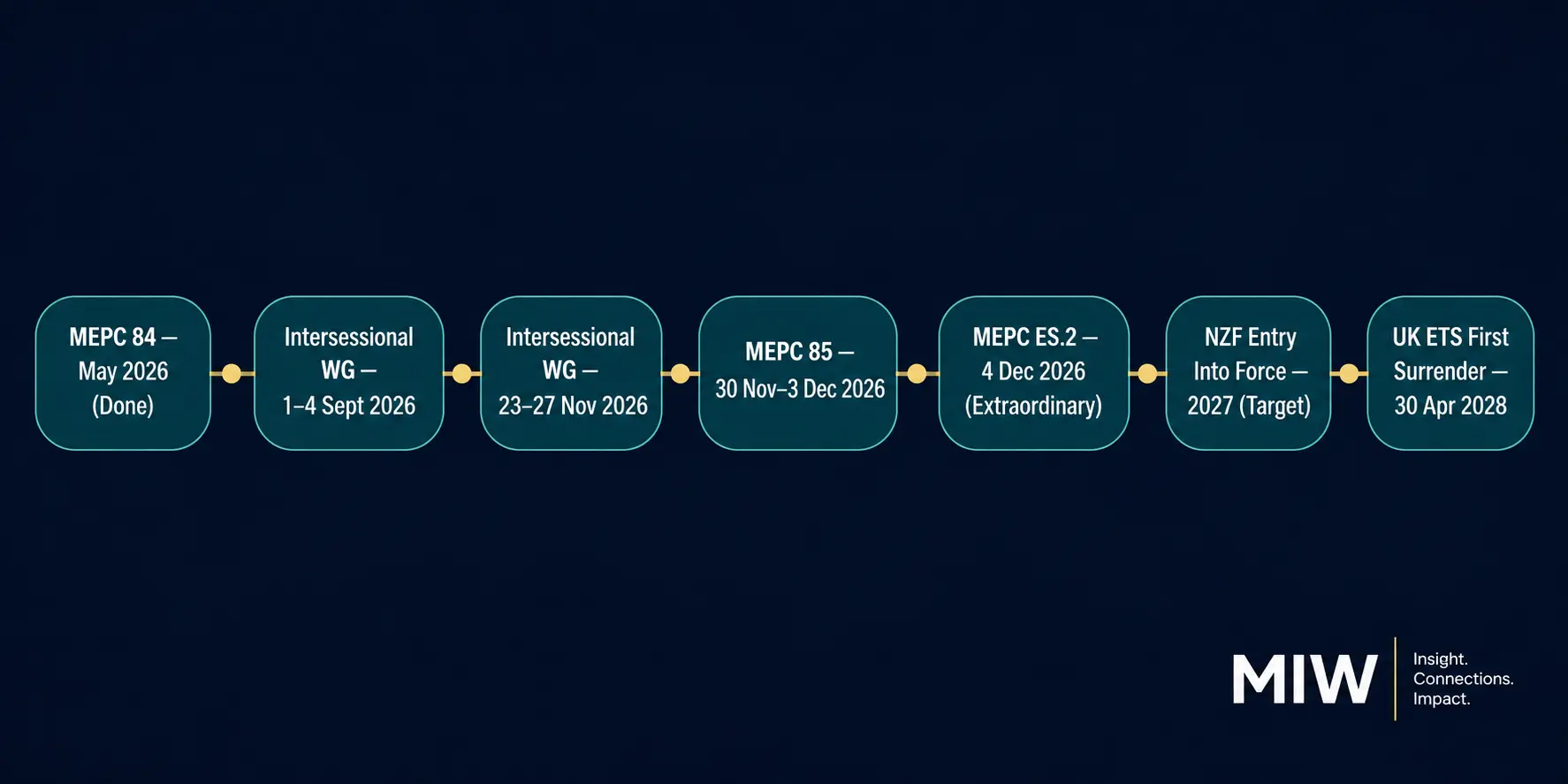
MEPC 85 Regulatory Timeline — from MEPC 84 to UK ETS first surrender 2028

IMO Net-Zero Framework — Key Dates to December 2026 and Beyond

December 2026 is not a horizon. It is a deadline.

The IMO Net-Zero Framework is a specific legal instrument — a GHG levy mechanism scheduled for adoption at MEPC 85 (30 November – 3 December 2026) and at MEPC ES.2, the extraordinary session of the Marine Environment Protection Committee that resumes on 4 December 2026. Two intersessional working group meetings are already confirmed: 1–4 September and 23–27 November 2026. A dedicated expert workshop on chain-of-custody fuel models — tracking fuel origin and emissions across the supply chain — will also be held before MEPC 85.

This schedule matters operationally. It means the framework terms are being finalised now, in the intersessional period. Member states are submitting amendments. The chain-of-custody workshop signals that how fuel origin is verified will be a live design question, not a settled assumption, when the levy is adopted.

If adopted on schedule, it will be the first time a price has been placed directly on maritime carbon emissions at the international level. The mechanism under discussion is a Greenhouse Gas Fuel Intensity (GFI) standard, supported by a levy on vessels that exceed the permitted intensity threshold. Revenue from the levy would be channelled into the IMO Net-Zero Fund (NZF) — financing alternative fuel infrastructure, capacity-building in developing states, and maritime decarbonisation research.
"GFI measures fuel choices — not just emissions. The bunkering decision is now also the compliance decision."

The practical consequence for shipboard management is not the levy rate itself — it is what the levy measures. GFI compliance is calculated using the Well-to-Wake carbon intensity of the fuel, which means:

  • The choice of fuel at bunkering directly affects GFI compliance, not just CII.
  • Methane slip on LNG vessels counts against GFI — combustion optimisation and engine tuning are compliance inputs, not just performance parameters.
  • Shore power and onboard renewable energy can positively affect GFI calculations.
  • SEEMP Part III will need to reflect GFI monitoring obligations if the framework is adopted in December.
SEEMP Part III — What changes after MEPC 85

Current SEEMP Part III covers CII rating, annual review, and corrective action plans. Post-MEPC 85, if the NZF levy is adopted, expect:

  • GFI monitoring added alongside CII reporting
  • Well-to-Wake fuel data requirements at bunkering
  • New data fields for methane slip and N₂O (flagged at MEPC 84 as voluntary for 2025–26 reporting cycles; likely mandatory in the GFI context post-MEPC 85)
  • Enhanced record-keeping connecting SEEMP to levy calculation

CII operational reminder: A "D" rating for three consecutive years, or an "E" rating in any single year, triggers a mandatory SEEMP corrective action plan under MARPOL Annex VI, Regulation 28. This remains in force independently of the NZF framework. Shipboard management must understand both instruments and how they interact operationally.

What if MEPC 85 is delayed? The NZF has already been deferred once. Political disagreement between developed and developing states on levy rate, fund allocation, and chain-of-custody rules remains the primary friction point; some major flag-state delegations have signalled resistance to a mandatory levy at this stage. If December 2026 produces only a framework decision rather than full adoption, a 2027 entry-into-force timeline becomes likely. The monitoring obligations — GFI reporting, methane slip measurement — are expected to proceed regardless of levy timing.

Management-level view: Begin tracking your vessel's GFI-relevant data now. The reporting infrastructure should be in place before the levy mechanism is live, not after. Coordinate with the technical superintendent on whether the SEEMP Part III requires amendment before December 2026.

Why this matters onboard
  • The GFI levy will make the bunkering decision a compliance decision — not just a commercial one. Cargo superintendents and technical managers will need to align.
  • SEEMP Part III amendments post-MEPC 85 will create new onboard record-keeping obligations. Shipboard teams should not wait for the circular to start structuring data.
  • For MEO Class 1 oral candidates: connect GFI, CII, and SEEMP Part III as a single integrated compliance system — not three separate instruments.

Source: IMO GHG work programme; MEPC 84 outcomes; MarineLink / IMO Secretary-General statement, 3 May 2026 | Regulatory reference: MARPOL Annex VI, Regulation 28 (CII); Regulation 26 (SEEMP)

Regulatory Watch

Developments from June 2026

Regulatory developments from June 2026 not covered in the previous issue.

IMO · GHG Framework

MEPC 85 and MEPC ES.2 — December 2026 adoption target

Both sessions are in December 2026. MEPC 85 is a regular session (30 Nov – 3 Dec); MEPC ES.2 is the extraordinary session resuming 4 December, convened specifically for the GHG levy adoption. This is the most consequential IMO regulatory event of the next six months.

  • 1–4 September 2026Intersessional Working Group meeting 1
  • 23–27 November 2026Intersessional Working Group meeting 2
  • 30 Nov – 3 Dec 2026MEPC 85 regular session
  • 4 December 2026MEPC ES.2 resumes (extraordinary, GHG levy)
  • 2027 (target)NZF entry into force if adopted Dec 2026
  • 30 April 2028First UK ETS allowance surrender (2026+2027 combined)

An expert workshop on chain-of-custody fuel models will be held before MEPC 85, addressing how fuel origin and emissions are traced and verified across the supply chain. This directly affects how GFI compliance is calculated and reported.

IMO GHG work programme · MARPOL Annex VI, Regulation 28 (CII) · MEPC 84 outcomes · MarineLink, 3 May 2026

UK ETS · SEEMP

UK ETS maritime — in force 1 July 2026

Status update only — mechanism explained in Issue 25. Scope: cargo and passenger ships ≥5,000 GT on UK-related voyages. Offshore vessels ≥5,000 GT from 1 January 2027. Covers CO₂, CH₄, and N₂O.

The three most common data quality failures in ETS reporting:

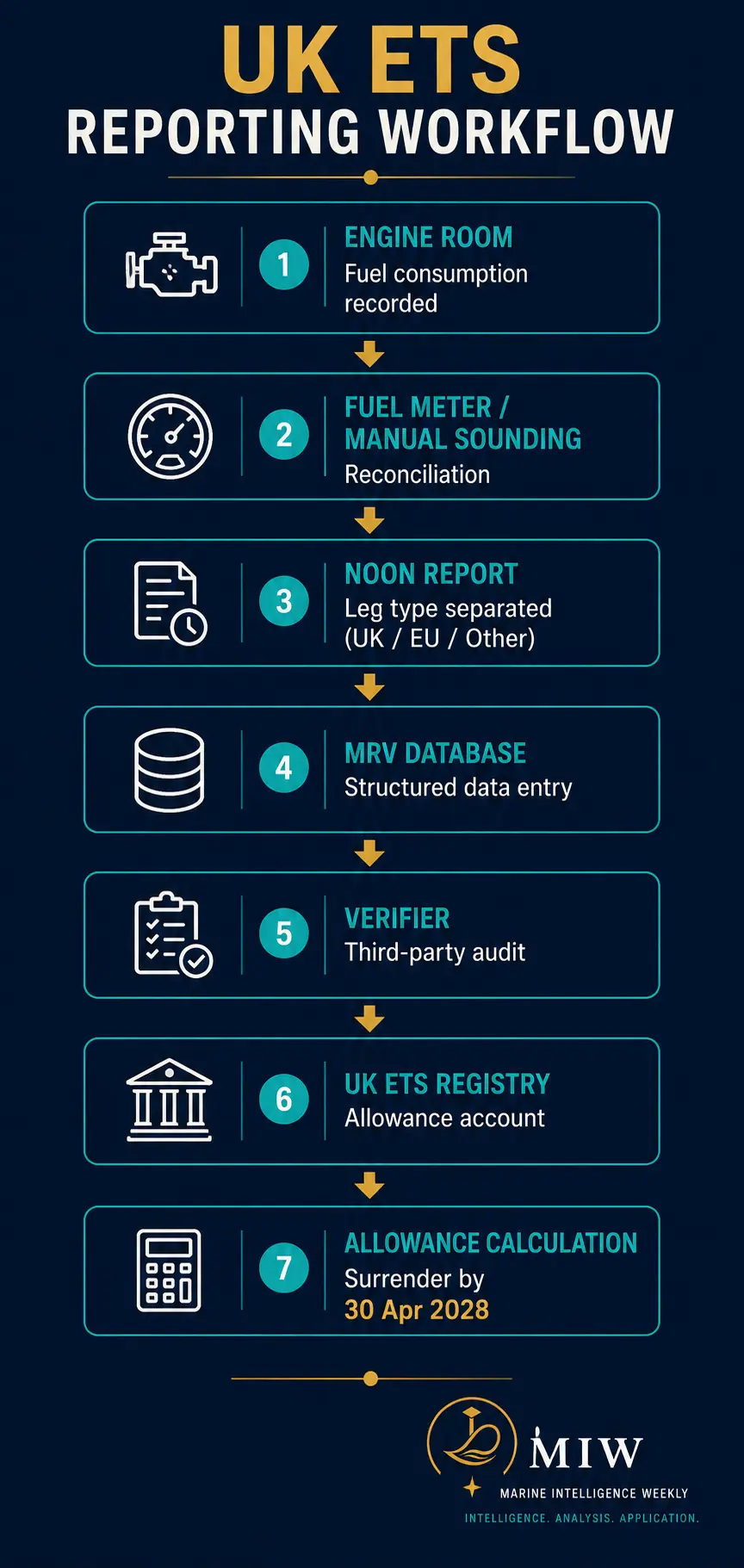
  1. Fuel split errors: Consumption not separated between UK-covered, EU-covered, and non-covered legs. A noon report that aggregates across leg types is not compliant.
  2. Meter-versus-BDN reconciliation: The reported figure must be the verified, reconciled quantity — not the meter reading substituting for bunker reconciliation.
  3. Methane and N₂O omissions: UK ETS covers CO₂, CH₄, and N₂O. LNG-fuelled vessels reporting only CO₂ are non-compliant.

The first UK ETS allowance surrender covers 2026 and 2027 combined, due 30 April 2028. Financial exposure from data errors accumulates now — not at surrender.

UK ETS Reporting Workflow — Engine Room to Allowance Calculation

UK ETS Reporting Workflow — 7-Step Chain from Engine Room to Allowance Surrender

Immediate checklist — shipboard management
  • Fuel flow meters, torque meters, shaft power systems: calibrated and reconciled with manual soundings.
  • Noon reports for UK arrival/departure legs: in-port, manoeuvring, and sea consumption separated cleanly.
  • Methane and N₂O continuous monitoring parameters confirmed logged within the automated data-handling infrastructure for LNG/dual-fuel vessels.
  • SEEMP Part III and Monitoring Plan confirmed UK ETS-compliant.
"The first reporting window is where the gap between what the SMS promises and what the data shows becomes visible. Close that gap now."
— Nixon Antony, Second Engineer, Maersk A/S
Why this matters onboard
  • UK ETS and EU ETS run in parallel — a vessel trading both markets must maintain two separate accounting trails from the same noon report.
  • The 30 April 2028 surrender date is 22 months away. Data errors compounding over that window create significant financial exposure before any corrective action.
  • Verification auditors examine the full chain from meter calibration record to MRV database entry. Gaps at any step are a finding.

UK ETS Order 2020 (as amended) · UK MRV Regulations revoked 3 April 2026 · SEEMP Part III (MARPOL Annex VI, Regulation 26)

DGS · Security Alert

DGS Circular No. 31 of 2026 — Gulf Security Mandate

⚠ Most Urgent — Security Alert

The Directorate General of Shipping issued DGS Circular No. 31 of 2026 on 13 June 2026, signed by Deputy DG of Shipping (Crew), ordering a heightened security posture for all vessels transiting the Persian Gulf, Strait of Hormuz, and Gulf of Oman.

The circular follows serious kinetic incidents involving three vessels with Indian crew: MT Marivex, MV Jalveer, and MT Settebello — the last of which suffered three fatalities. All RPSL agencies and shipping companies are formally advised to restrict deployment of Indian seafarers to regional conflict zones until further notice. Emergency crew changes now strictly require documented seafarer consent.

Masters transiting these sectors must enforce maximum security protocols, maintain 24/7 communication with the DG Communication Centre (MMDAC), and log all security measures formally in the ship's official log. Companies are instructed to implement psychological support for crew members experiencing high stress in active corridors.

🇮🇳 India Angle — Hong Kong Convention: First Operational Anniversary, 26 June 2026

The Hong Kong International Convention for the Safe and Environmentally Sound Recycling of Ships entered force globally on 26 June 2025. This Friday marks its first operational anniversary. India remains a dominant compliant recycling hub with Alang yards among the primary certified facilities. Shipboard management teams on older tonnage must treat the Inventory of Hazardous Materials (IHM) as an active SMS maintenance item — not a commercial afterthought.

DGS Circular No. 31 of 2026 · ISPS Code, Chapter XI-2 (SOLAS) · ISM Code, Section 7 · Hong Kong Convention (2009) · EU Ship Recycling Regulation 1257/2013

IMO · TC Committee

IMO Technical Cooperation Committee — June 2026

The IMO TC Committee met 8–12 June 2026, reviewing decarbonisation capacity-building projects including GreenVoyage2050, the MTCC network, and NextGEN. Many vessels in LDC and SIDS flag-state fleets are becoming testbeds for IMO-supported retrofits — voyage optimisation software, hull coatings, and alternative fuel trials.

Oral examination point: IMO decarbonisation work is being operationalised through TC-supervised programmes. GreenVoyage2050 and the MTCC network provide tools and training — cite these by name when discussing IMO implementation mechanisms.

IMO Technical Cooperation Committee work programme · GreenVoyage2050

AI in Maritime

From Assurance to Adoption — Three Developments

Distinct from the ABS AI report and two-stroke predictive maintenance coverage in Issue 25.

DNV · Autonomy · Cyber

DNV autonomous ships — class notations now operational

DNV's autonomous-ships class notation framework now covers remotely operated ships with a defined safety-assurance path. Remote control and reduced-manning concepts are entering class-managed implementation. Systems architecture, redundancy, failure modes, and remote intervention procedures will be auditable items — not just design characteristics.

DNV's parallel cyber-risk guidance is explicit: AI tools connected to OT systems, PMS, or remote support links must be treated as part of the vessel's cyber perimeter. Maritime operators adopting AI-based monitoring should review access control, patching, vendor link permissions, and fallback modes before deployment.

Onboard takeaway: If your vessel uses any remote diagnostic or condition-monitoring platform connected to a shore centre, confirm the cyber governance around that link — who has access, under what conditions, and what the fallback procedure is if the connection is compromised.

Why this matters onboard
  • Class notations for autonomous operations will begin appearing on vessels operating in trial corridors — maritime professionals will encounter them in surveys and PSC.
  • Remote intervention procedures and fallback control modes are engineer's territory, not just a navigation concern.
  • Cyber governance around AI tools is now an auditable class requirement, not an IT department concern.

IACS UR E26 and UR E27 · IMO MSC-FAL.1/Circ.3 · IMO Maritime Digitalisation Strategy (target: end 2027)

DNV · Cargo · AI Deployment

DNV Steel Load Planner V2.0 — 100+ vessels, Posidonia 2026

DNV's SLP V2.0 — launched at Posidonia 2026 — is now deployed across 100+ vessels. The new version extends beyond bulk carriers to general cargo and multi-purpose vessels, with automated coil planning introduced. AI-generated structural assessment in under five minutes replaces a process that previously required specialist manual analysis.

This is the clearest current example of AI moving from concept to measurable fleet-scale deployment within a class-governed process.

"The AI generates the plan. The officer takes responsibility for the approval. That boundary does not move."

Operational implication: Any AI-generated loading plan still requires Master/Chief Officer endorsement under SOLAS II-1 structural integrity obligations. AI accelerates the analysis — it does not transfer the legal responsibility.

Why this matters onboard
  • AI-generated cargo plans will become standard on vessels using SLP V2.0 — familiarity with how to validate AI output against manual checks is a practical skill.
  • The speed advantage (five minutes vs hours) will create commercial pressure to approve plans quickly. The endorsement obligation remains unchanged.
  • This is a live example for MEO oral answers on AI in maritime operations — cite SLP V2.0, 100+ vessels, Posidonia 2026.

DNV Steel Load Planner V2.0 Launch — Posidonia 2026

DNV · SMF · Workforce

Future of Seafarers 2030 — what the study says for Class 1 candidates

DNV and the Singapore Maritime Foundation published the Future of Seafarers 2030 study in June 2026, forecasting sharp demand increases for maritime professionals competent in alternative fuels, data analytics, remote monitoring, and integrated ship systems — alongside traditional mechanical skills.

Ship management will be increasingly data-driven. Maritime professionals will collaborate directly with shore-based performance centres using digital tools for diagnostics and statutory compliance. This is already happening on vessels with advanced PMS, digital twins, and ETS-driven fuel monitoring.

MEO Class 1 oral implications:

  • Function 1 (Marine Engineering, Management Level): Alternative fuel properties and systems — LNG, methanol, ammonia, hydrogen — and associated IGF-type safety regimes are core examination topics.
  • Data and compliance: Articulate how engine parameters, hull performance data, and automated fuel logging feed CII, ETS, and charter-party verification.
  • Leadership: Senior professionals must build a culture where ECR workstations and digital logging systems are primary compliance tools, not administrative overhead.
Why this matters onboard
  • The 2030 study is a signal from class and industry about where certification and career development are heading — not a distant forecast.
  • Shore-side performance centres are already active on major fleets. The interface between shipboard data and shore-based decisions is a daily operational reality.
  • Maritime professionals who cannot articulate data-to-compliance linkages will be less competitive for Chief Engineer and superintendent roles.

DNV / Singapore Maritime Foundation — Future of Seafarers 2030, June 2026

Classification Insights

Four New Class Developments — All Post Issue 25

LR · Hydrogen · Type Approval

LR type approves world's first 100% hydrogen marine engine

Lloyd's Register issued the first Type Approval Certificate for a 100% hydrogen-fuelled, spark-ignited marine engine developed by BeHydro on 17 June 2026. Hydrogen moves from concept to class-approved propulsion, sitting alongside ammonia and methanol as credible future fuels under IMO's net-zero strategy.

"Hydrogen is no longer experimental. It is class-approved."

Technical characteristics — distinct from LNG and methanol:

Ignition energy
~0.017 mJ
cf. methane ~0.28 mJ
Flammability range
4–75% (vol)
LNG: 5–15%
Molecular weight
2 g/mol
Rapid upward dispersion
Embrittlement risk
High pressure
Material selection critical

Required safety controls beyond IGF Code basics:

  • Double-wall piping with inert gas purging in the annular space
  • Dedicated hydrogen gas detection (catalytic bead and electrochemical sensors)
  • Emergency shutdown logic designed for near-zero ignition energy threshold
  • Revised hot-work regimes: greater exclusion zones, lower residual risk tolerance
  • Ventilation rates designed for 4–75% flammability envelope, not LNG assumptions
Why this matters onboard
  • Alternative fuel questions will feature in MEO Class 1 orals — hydrogen properties and safety controls are now examinable as a class-approved system.
  • Future newbuilds and retrofits will increasingly reference hydrogen-ready design principles — material compatibility decisions start at the design stage.
  • The safety gap between hydrogen and conventional fuels is wider than LNG — shore and shipyard briefings will need to address this explicitly.

IGF Code (SOLAS Ch. II-1, Part G) · IEC 60079 series · LR Type Approval Certificate — BeHydro, 17 June 2026

LR · HD Hyundai · Hybrid-Electric

LR + HD Hyundai — hybrid-electric LNG carrier JDP

LR, HD Korea Shipbuilding & Offshore Engineering, and HD Hyundai Heavy Industries launched a Joint Development Project for a 185,000 cbm LNG carrier with hybrid-electric propulsion — combining engines, power electronics, and energy storage to optimise prime-mover loading.

Specific new competency requirements for Chief Engineers on such vessels:

  • Integrated power systems: DC bus architecture, load-sharing logic, spinning reserve
  • Battery safety: thermal runaway recognition, ventilation requirements, BMS monitoring
  • Emergency procedures: partial DC bus loss, battery isolation, propulsion mode switching
  • Condition-based maintenance on converters, inverters, and power electronics

Engine-room implication: The alarm management and emergency response framework for a hybrid-electric plant differs fundamentally from a diesel-only or diesel-electric arrangement. Failure mode analysis and crew familiarisation are prerequisites, not commissioning afterthoughts.

Management-level action: Review IEC 62619 battery safety requirements and your vessel's emergency procedures for DC bus fault conditions before taking charge on any hybrid or battery-integrated plant.

Why this matters onboard
  • Hybrid propulsion is moving from offshore and ferry sectors into large gas carriers — maritime professionals on LNG tonnage should begin building familiarity now.
  • Battery thermal runaway in a machinery space is a categorically different emergency response from a conventional fire.
  • Shore-side technical teams will need condition-monitoring competence for power electronics — not just mechanical overhaul expertise.

IGF Code (LNG provisions) · IEC 62619 (battery safety) · SOLAS II-1 (electrical installations)

DNV · LPG · Container · AiP

DNV — LPG dual-fuel 1,400 TEU container vessel AiP

DNV granted Approval in Principle to HD Hyundai Heavy Industries' LPG dual-fuel container vessel concept on 4 June 2026. First LPG dual-fuel AiP in the container segment at this size — direct relevance for feeder and regional trade.

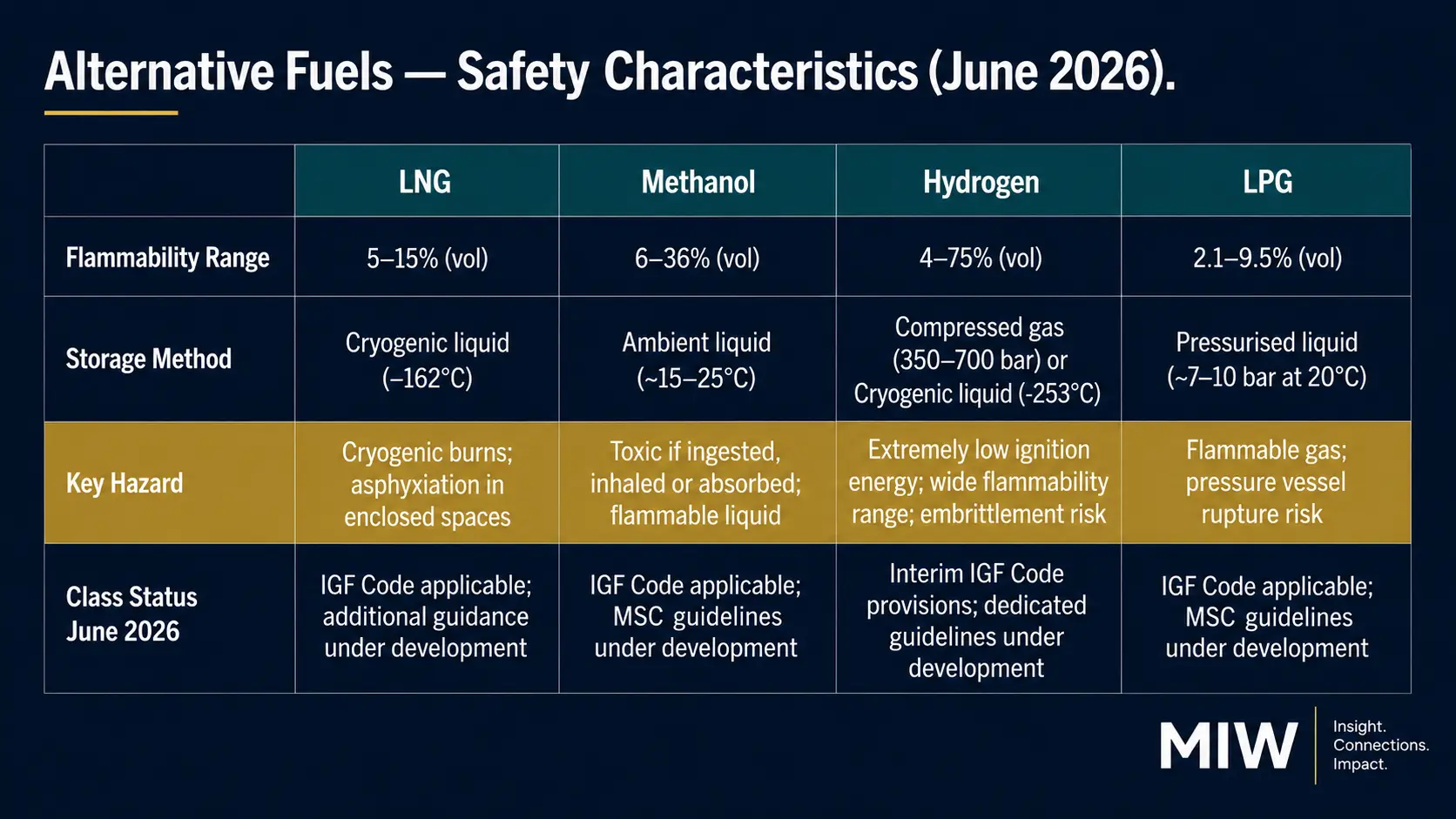
Alternative Fuels Safety Characteristics Comparison — LNG, Methanol, Hydrogen, LPG (June 2026)

Alternative Fuels — Safety Characteristics Comparison (June 2026)

Key LPG characteristics as marine fuel:

  • Propane (C₃H₈) and butane (C₄H₁₀) mix; stored as liquid under moderate pressure
  • Flammability: propane 2.1–9.5%; butane 1.8–8.5%
  • Heavier than air — sinks and pools; ventilation and gas detector placement differ fundamentally from LNG/methane (which rises)
  • No methane slip — GFI advantage over LNG
Why this matters onboard
  • LPG dual-fuel container vessels will enter commercial service this decade — maritime professionals on container tonnage should build awareness now.
  • Gas detector placement logic for heavier-than-air fuels is opposite to LNG — a procedural gap that must be addressed in familiarisation programmes.
  • LPG's GFI advantage over LNG may drive faster adoption if the NZF levy is adopted in December 2026.

IGF Code (LPG provisions) · IGC Code · IMO MSC/Circ.1483

LR · Digital · Data Quality

LR Digital Disconnect Initiative — data quality as class infrastructure

Lloyd's Register expanded its maritime digital services on 1 June 2026, targeting the "digital disconnect" — the gap between fragmented onboard data and the unified compliance platforms that EU/UK ETS, IMO DCS, and ESG reporting now require.

"Poor shipboard records no longer just risk a PSC deficiency. They risk a charter-party dispute and an ESG audit finding."

Operational implications:

  • Structured data entry (event codes, dropdowns) is replacing free-text log entries — free text cannot feed compliance models reliably
  • Edge devices and cloud-linked loggers are becoming class-expected infrastructure on vessels with digital notation
  • Cyber-security controls on OT networks are access conditions for remote survey and digital twin services — not optional add-ons

Onboard takeaway: If your vessel operates under any condition-based survey agreement or digital class notation, confirm what data the PMS is feeding to the shore platform, who has access, and what happens to compliance claims if that data feed fails.

Why this matters onboard
  • The data your ship produces today is the evidence base for commercial and regulatory decisions made ashore tomorrow.
  • Remote survey and continuous class monitoring depend on clean, structured data feeds — vessels with poor data hygiene will lose access to these services.
  • Cyber incidents targeting OT networks now carry direct compliance consequences — a corrupted data feed can invalidate an ETS report or CII calculation.

IACS UR E26 (OT cyber) · UR E27 (cyber resilience) · IMO MSC-FAL.1/Circ.3 · MARPOL Annex VI, Regulation 22A (IMO DCS)

Nixon's Voice

The Engine Room's New Metric

Nixon Antony
Nixon Antony
2E · Maersk A/S · MEO Class 1

Issue 25 closed with a note on technostress — the specific fatigue of managing multiple complex systems, each with its own interface and alarm logic, on a vessel where the pace of regulatory change does not pause for implementation.

This week, sitting with the UK ETS live start and the MEPC 85 countdown in front of me, the thought that stays with me is simpler: the engine room has always been the ship's compliance department. What has changed is that the records we keep are now feeding systems we cannot always see — ETS platforms, digital twin dashboards, shore-based performance centres — and the consequences of poor data quality are no longer limited to a PSC deficiency. They are financial, commercial, and reputational.

I am preparing for MEO Class 1. The examiners at Kochi MMD will ask me about CII, SEEMP Part III, alternative fuels, and cyber-risk management. What they are testing is not recall — it is whether a candidate understands that these instruments interact operationally, not in isolation. A vessel running LNG that reports only CO₂ under UK ETS is not just non-compliant — it is exposing the company to a financial error that compounds over two reporting years before the first surrender date.

That kind of systems thinking — connecting regulation to operational practice to commercial consequence — is what the next generation of maritime leaders will need. It is also, I think, what MIW is trying to build, one issue at a time.

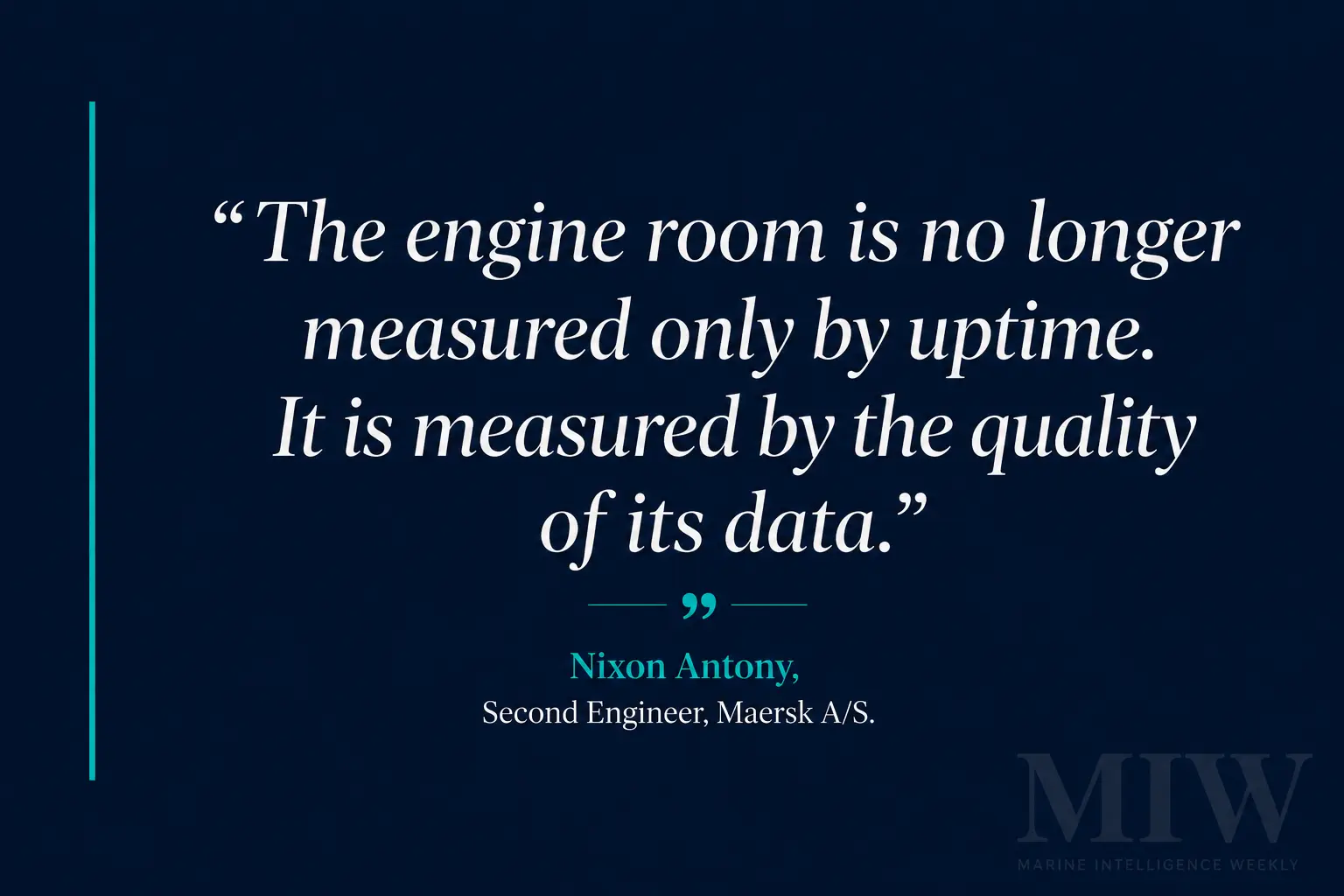
"The engine room is no longer measured only by uptime.
It is measured by the quality of its data.
That shift has already begun."
— Nixon Antony, Second Engineer, Maersk A/S
Nixon Antony pull quote — The engine room is no longer measured only by uptime
Practical Takeaway

Your Action List — Week of 24 June 2026

Priority Action Regulatory Link
🔴 URGENT Verify fuel metering calibration and data integrity — UK ETS live 1 July. Separate UK, EU, and non-covered legs in noon reports. CH₄ and N₂O streams active for LNG/DF vessels. UK ETS Order 2020; SEEMP Pt III (MARPOL Ann. VI R.26)
🔴 URGENT Confirm SEEMP Part III and Monitoring Plan are UK ETS-compliant before 1 July. Check with superintendent if amendment is required. UK ETS Order 2020; UK MRV revoked 3 April 2026
🟠 HIGH Enforce DGS Circular No. 31/2026 security posture if transiting Gulf/Hormuz/Oman waters. Confirm 24/7 MMDAC communication active. Document all security measures in official log. Emergency crew change requires documented seafarer consent. DGS Circular No. 31 of 2026; ISPS Code Ch. XI-2; ISM Code Sec. 7
🟠 HIGH Begin tracking GFI-relevant data now — fuel type, Well-to-Wake intensity, methane slip (LNG). MEPC 85 GFI levy adoption December 2026 may trigger SEEMP Part III amendment. MARPOL Ann. VI R.28; IMO NZF work programme
🟠 HIGH Check CII rating trajectory. "D" for 3 consecutive years or "E" in any year triggers mandatory SEEMP corrective action. Identify operational interventions now, not at year-end. MARPOL Ann. VI R.28; CII Guidelines (MEPC.338(76))
🟡 MEDIUM For LPG-trading vessels or newbuild awareness: review DNV AiP scope. Ventilation and gas detection for heavier-than-air gas differ fundamentally from LNG/methanol arrangements. IGF Code; IGC Code; IMO MSC/Circ.1483
🟡 MEDIUM Audit OT cyber controls on any vessel with digital class notation or remote monitoring: USB blocking, network segmentation, remote-access logging — all current? IACS UR E26/E27; IMO MSC-FAL.1/Circ.3
🟡 MEDIUM Machinery space fire prevention: inspect hot-surface lagging after any overhaul. Verify oil-leak screening on injection and lubrication lines near high-temperature surfaces. DNV fire prevention guidance; SOLAS II-2, Reg 4
🟢 ONGOING For EAL/stern-tube arrangements: trend bearing temperature and seal leakage tightly. EAL viscosity margin under high load or low temperature is narrower than mineral oil. MARPOL Ann. I; DNV shaft/lubrication guidance
🟢 ONGOING Verify emergency generator test records and automatic load transfer readiness before inspection port arrivals. SOLAS II-1, Reg 43; ISM Code, Sec. 10
Coming in Issue 27 · 1 July 2026
UK ETS Day One — What the First Reports Reveal

Early compliance signals and first reporting challenges from UK ETS Day One. How EU ETS and UK ETS interact for vessels trading both markets. What data quality problems are emerging in the first reporting window. Plus: MEPC ES.2 preparations and what the GHG levy negotiation status means for operators making fuel procurement decisions for 2027.

Sources

References

  1. IMO — GHG work programme and NZF documentation
    imo.org/en/OurWork/Environment/Pages/IMO-2050-GHG-Strategy.aspx
  2. IMO — MEPC 84 outcomes
    imo.org/en/MediaCentre/MeetingSummaries/Pages/MEPC-84th-session.aspx
  3. IMO — Technical Cooperation Committee, June 2026
    imo.org/en/OurWork/TechnicalCooperation
  4. DNV — UK ETS expansion to maritime from 1 July 2026
    dnv.com
  5. UK Government — UK ETS Order 2020 (as amended for shipping)
    legislation.gov.uk
  6. Lloyd's Register — BeHydro 100% Hydrogen Engine Type Approval, 17 June 2026
    lr.org
  7. LR + HD Hyundai — Hybrid-Electric LNG Carrier JDP
    lr.org/en/latest-news/
  8. LR — Digital Disconnect Initiative, 1 June 2026
    lr.org/en/latest-news/
  9. DNV — LPG Dual-Fuel 1,400 TEU Container Vessel AiP, 4 June 2026
    dnv.com/news/2026/
  10. DNV — Future of Seafarers 2030 (DNV + Singapore Maritime Foundation)
    dnv.com/maritime/
  11. DNV — Autonomous Ships Class Notations
    dnv.com/maritime/autonomous-ships/
  12. DNV — Steel Load Planner V2.0, Posidonia 2026
    dnv.com
  13. IACS — Unified Requirements E26 and E27
    iacs.org.uk
  14. IMO — MSC-FAL.1/Circ.3 (Maritime Cyber Risk Management)
    imo.org
  15. MarineLink — IMO Progresses Net Zero Framework, 3 May 2026
    marinelink.com
  16. IMO — Hong Kong Convention for Safe and Environmentally Sound Recycling of Ships
    imo.org
  17. Directorate General of Shipping, India — DGS Circular No. 31 of 2026 (Gulf Security Advisory, 13 June 2026)
    dgma.gov.in