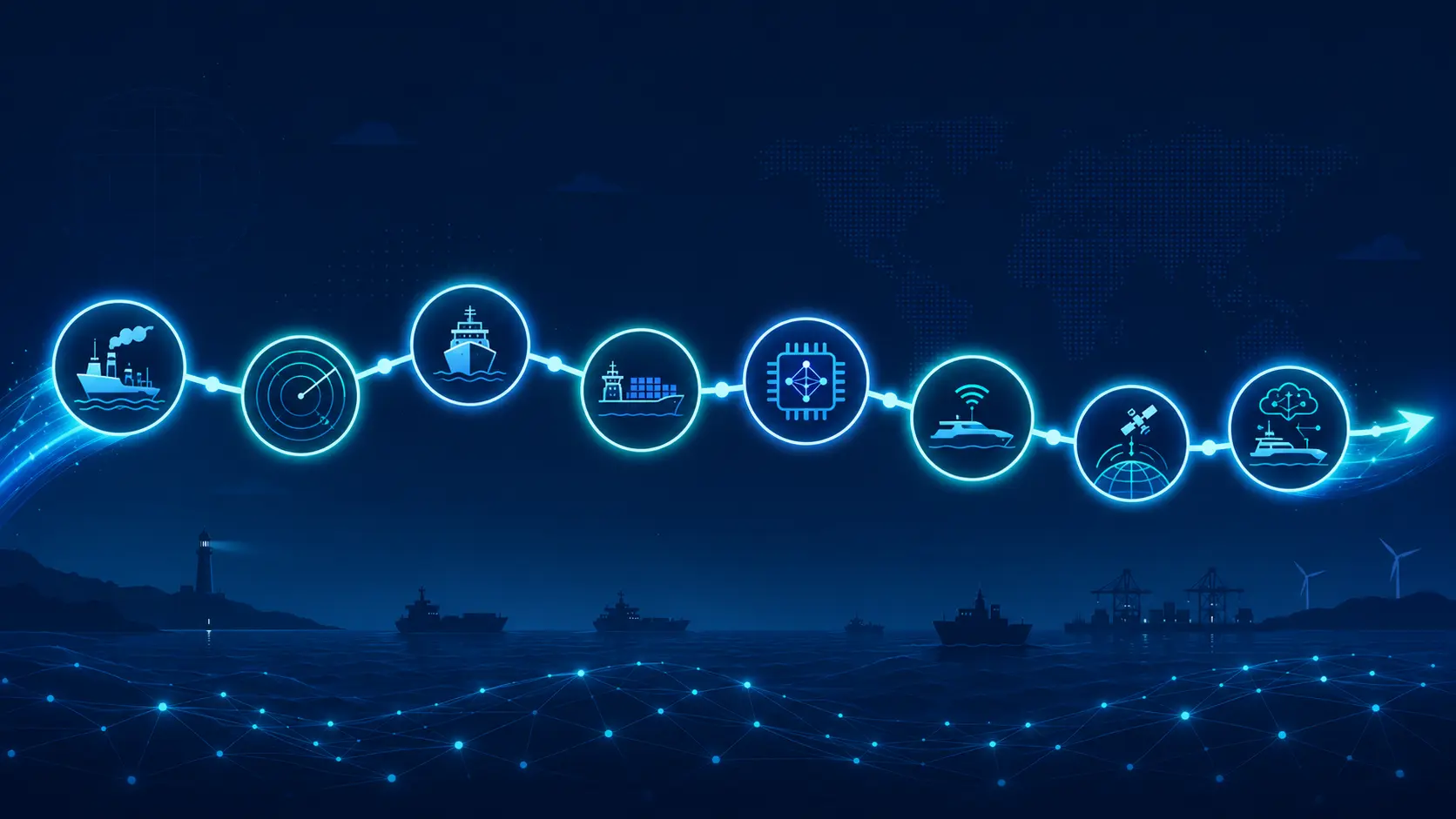
When you try to identify the moment maritime changed, you can't. There isn't one. What there is, instead, is a sequence — a chain of decisions, demonstrations, regulatory adoptions, and commercial deployments that, looked at in aggregate, describe an industry that has moved further in fifteen years than in the previous fifty.
The MIW AI in Maritime Timeline is an attempt to make that sequence visible. Not a curated highlight reel. Not a retrospective shaped by hindsight. A contemporaneous record — every significant milestone placed in order, sourced to its primary origin, and assessed for what it actually changed.
Why build a timeline at all?
The maritime industry has a problem with institutional memory. Events that were consequential — the adoption of IACS UR E26/E27, the Prism Courage crossing, the publication of ISO 19847 — fade from active professional knowledge within months of occurring. They get compressed into bullet points, stripped of context, or simply forgotten. When the next generation of regulations references them, practitioners struggle to reconstruct why those decisions were made.
A timeline built on primary sources solves a specific problem: it gives maritime professionals a single reference that answers the question what actually happened, and when? — without requiring them to re-excavate IMO meeting summaries, class society circulars, and press releases every time context is needed.
"The professionals who understand AI today will shape the shipping standards of tomorrow."
Marine Intelligence Weekly, Issue 21 — Maritime AI in Its Evidence PhaseFive eras. One arc.
The timeline is structured across five distinct eras, each with a different character and a different set of actors driving change.
Policy frameworks, AIS mandates, e-navigation begins. The regulatory and data infrastructure that made everything subsequent possible.
The Initial GHG Strategy. First autonomous demonstrations. ISO 19847/48 standardises machinery data. BIMCO cyber guidelines. The industry begins to anticipate what is coming.
COVID forces remote survey technology to scale. MEGURI2040 launches. EEXI and CII adopted. Digital twins move from R&D to commercial fleet deployment.
Mayflower crosses the Atlantic. Prism Courage crosses the Pacific. South Korea passes the world's first MASS Act. LEO SatCom changes the connectivity equation. CII enters force.
The MASS Code adopted at MSC 111. A crewless vessel completes Singapore to Rotterdam. LR × Orca AI trial commences under class notation. JNPT and Mundra deploy port AI. The compliance stack — CII, EEXI, FuelEU, EU ETS — becomes fully active simultaneously. India moves from AI consumer to standards contributor.
What the timeline reveals
Three patterns become visible only when events are laid end to end.
The invisible infrastructure layer came first
Before any AI system could operate at fleet scale, the data had to exist in a usable form. The AIS mandate (2012) created the first universal vessel location dataset. ISO 19847 and ISO 19848 (2018–19) standardised machinery data logging so that digital twins could work across mixed-fleet owners. LEO SatCom (2023–24) provided the bandwidth that made real-time AI watchkeeping and remote surveys commercially viable. None of these events are glamorous. None generated headlines outside specialist press. But without them, HyperPilot, Orca AI, and OCEANS-X have no foundation to operate on.
ISO 19847 & ISO 19848 — standardised shipboard machinery data protocols published. The invisible foundation of the digital twin era.
Maritime LEO SatCom — Starlink and Eutelsat OneWeb slash latency from ~600ms to under 100ms at sea, enabling real-time AI watchkeeping at fleet scale.
Regulation follows proof, not ambition
The MASS Code took eight years from IMO's first scoping exercise (MSC 99, 2018) to adoption (MSC 111, 2026). That pace frustrates advocates of autonomous shipping. But the sequence explains the caution: MSC 99 begins the exercise before any large commercial vessel has made an autonomous ocean crossing. By MSC 111, there is a record — the Prism Courage, the Mayflower MAS400, the Suzaku in Tokyo Bay, the Genbu with its ClassNK notation, and the Singapore-Rotterdam crewless voyage. The MASS Code was not delayed by indifference. It waited for evidence.
South Korea moved faster precisely because it could legislate domestically rather than wait for international consensus. Norway formalised Remote Operator licences before the MASS Code provided a framework for them. Japan's MEGURI2040 programme generated the trial data that informed ClassNK's notation criteria. National legislation and class society standards were, in this cycle, the proving ground for the international instrument — not the other way around.
The compliance stack is, for the first time, complete
CII entered force in 2023. EEXI entered force in 2023. FuelEU Maritime on 1 January 2025. EU ETS reached 100% compliance on 30 April 2026. For the first time in maritime regulatory history, all four major GHG compliance instruments are simultaneously active on European trades. No single instrument is optional or deferred. The compliance stack is complete — and it is demanding enough that no ship company can manage it at fleet scale without AI-assisted voyage optimisation, carbon accounting, and fuel management tools.
This is, in effect, the regulatory mandate for AI adoption that no IMO resolution ever directly provided.
Key milestones in the Integration Era (2024–26)
- Deepsea HyperPilot — first AI propulsion system to receive DNV Type Approval as autonomous speed controller
- OCEANS-X Singapore — maritime's first open AI data exchange platform, backed by SGD 100M
- ClassNK AUTO-Nav2 (All) issued to Genbu — world's first commercially certified autonomous coastal vessel
- LR × Orca AI — first joint class-approved live AI collision avoidance trial
- Singapore to Rotterdam — first fully crewless transoceanic cargo voyage
- MSC 111 — MASS Code adopted, effective 1 July 2026 (non-mandatory)
- JNPT and Mundra Port — AI-driven container tracking and berth allocation deployed at scale
- EU ETS 100% compliance — maritime fully inside the carbon market from 30 April 2026
How the timeline is built
Every event on the timeline is sourced to a primary document — an IMO meeting summary, a class society circular, a government regulation, a company press release, or MIW editorial research where no primary public source exists. Events without a verifiable primary source are not included. Significance assessments are editorial judgments, not consensus positions.
The timeline is filterable by category. Each event can be viewed in the context of its era or in isolation. Events covered in MIW issues carry a publication badge linking back to the relevant issue.
The timeline will be updated as new milestones occur. Corrections and submissions are welcome at contactus@marineintelligenceweekly.com.
AI in Maritime: A Decade of Transformation
55+ sourced milestones. Five eras. Filterable by category. Updated as events occur.
Open the Timeline → Return to MIW