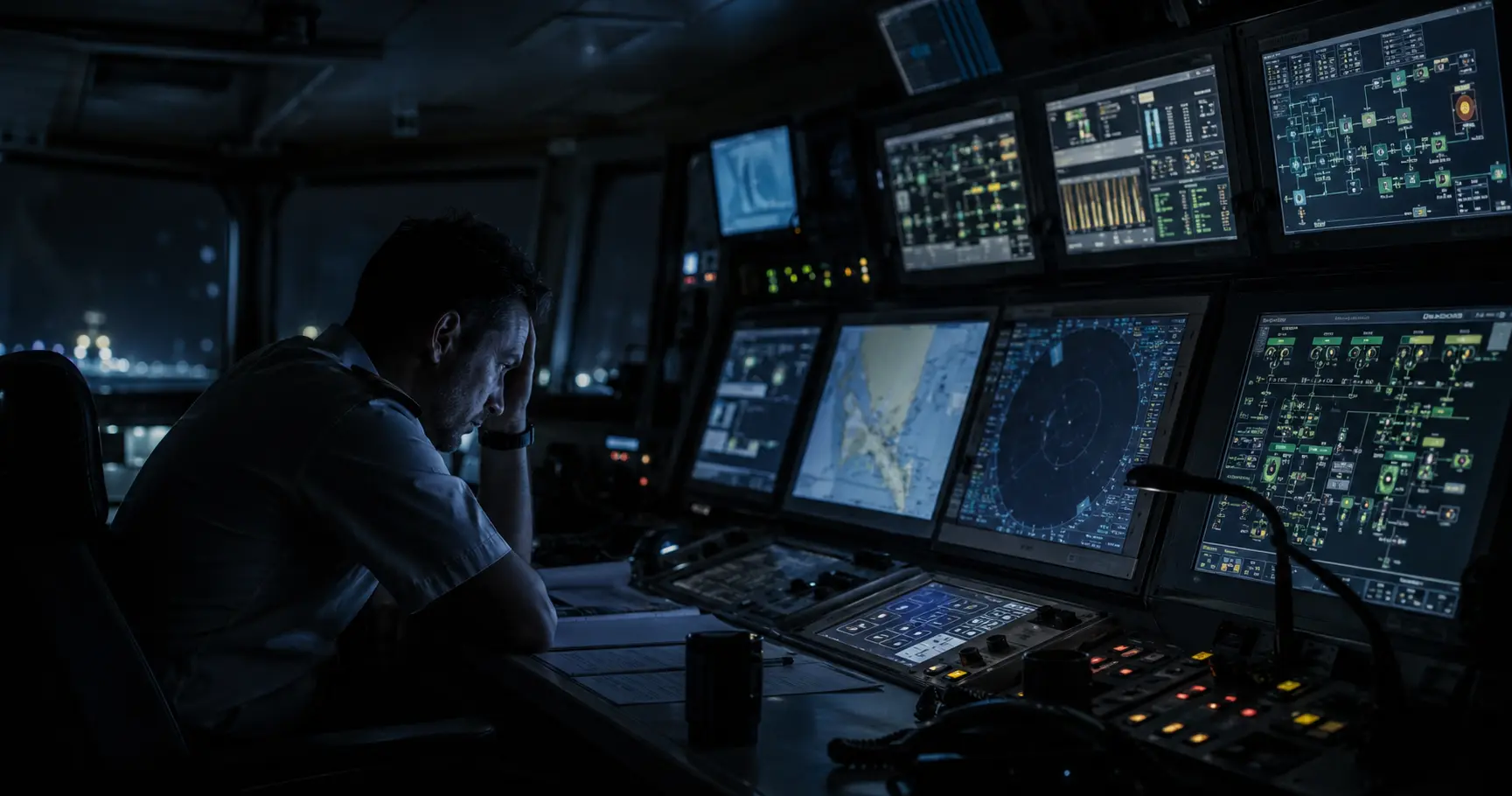
When we speak of maritime safety, the conversation almost always gravitates toward fire prevention, structural integrity, pollution control, or collision avoidance. Rarely do we pause to ask: What is the technology doing to the seafarer's mind?
As ships grow smarter, more automated, and perpetually connected, a silent crisis is emerging in the engine rooms and bridge wings of the world's merchant fleet — technostress. It is not a malfunction you can read on a gauge. It does not trigger a GMDSS alarm. Yet its consequences are real, measurable, and increasingly difficult to ignore.
What Exactly Is Technostress?
Technostress is the psychological strain experienced when a person is required to adapt to rapidly evolving and increasingly complex digital technologies — often without adequate preparation, support, or time to do so.
First coined by psychologist Craig Brod in 1984, the term originally described computer-age anxiety in office workers. Decades later, it has found a new, far more acute manifestation: the seafarer navigating Maritime 4.0.
On a modern vessel, a single engineer or officer may simultaneously manage Integrated Alarm Management Systems (IAMS), Electronic Chart Display and Information Systems (ECDIS), Planned Maintenance Systems (PMS), Ballast Water Management Systems, emissions monitoring platforms, and voyage optimisation software — all while standing a four-hour watch, responding to alarms, and managing a multinational crew.
Five Forms of Technostress Onboard
Research from the World Maritime University (WMU) and other leading institutions identifies five distinct dimensions of technostress as experienced by seafarers.
Techno-Overload
Seafarers are expected to manage six to eight major digital systems on any given watch. The cognitive load of processing multiple simultaneous inputs — alarms, readouts, logs, remote notifications — leads to mental exhaustion that compounds over a voyage. A 2025 study of 411 active seafarers confirmed techno-workload ranked among the highest stressors for officer-rank personnel.
Techno-Complexity
Modern shipboard systems have evolved far beyond the intuitive, analogue instruments of a generation ago. Some integrated systems require over a week of focused training just to understand the basics. When crew are rotated frequently and training is minimal, the result is a workforce perpetually playing catch-up with the machinery they are legally responsible for operating safely.
Techno-Invasion
A ship is both a workplace and a home. Unlike a shore-based engineer who can leave the office, a seafarer cannot escape the alarm panel. Night-time system alerts, emergency notifications, and remote monitoring intrusions blur the already thin boundary between rest and duty. Under MLC 2006, seafarers are entitled to minimum rest hours — but technology increasingly conspires against genuine rest, threatening both welfare and regulatory compliance.
Techno-Uncertainty
Software updates, system reconfigurations, and procedural changes introduced mid-voyage create anxiety around making critical mistakes — pressing the wrong input, losing operational data, or triggering a false alarm during a port state control inspection. A lack of standardisation across systems and environmental legislation further compounds this fear of administrative error.
Techno-Insecurity
As automation deepens, many experienced seafarers quietly fear redundancy. When MASS (Maritime Autonomous Surface Ships) and remote-operation centres are discussed at IMO level, the implicit message to the workforce is unsettling: your role is being redesigned around you, without you. Research confirms that change management remains largely unaddressed within maritime digital transformation.
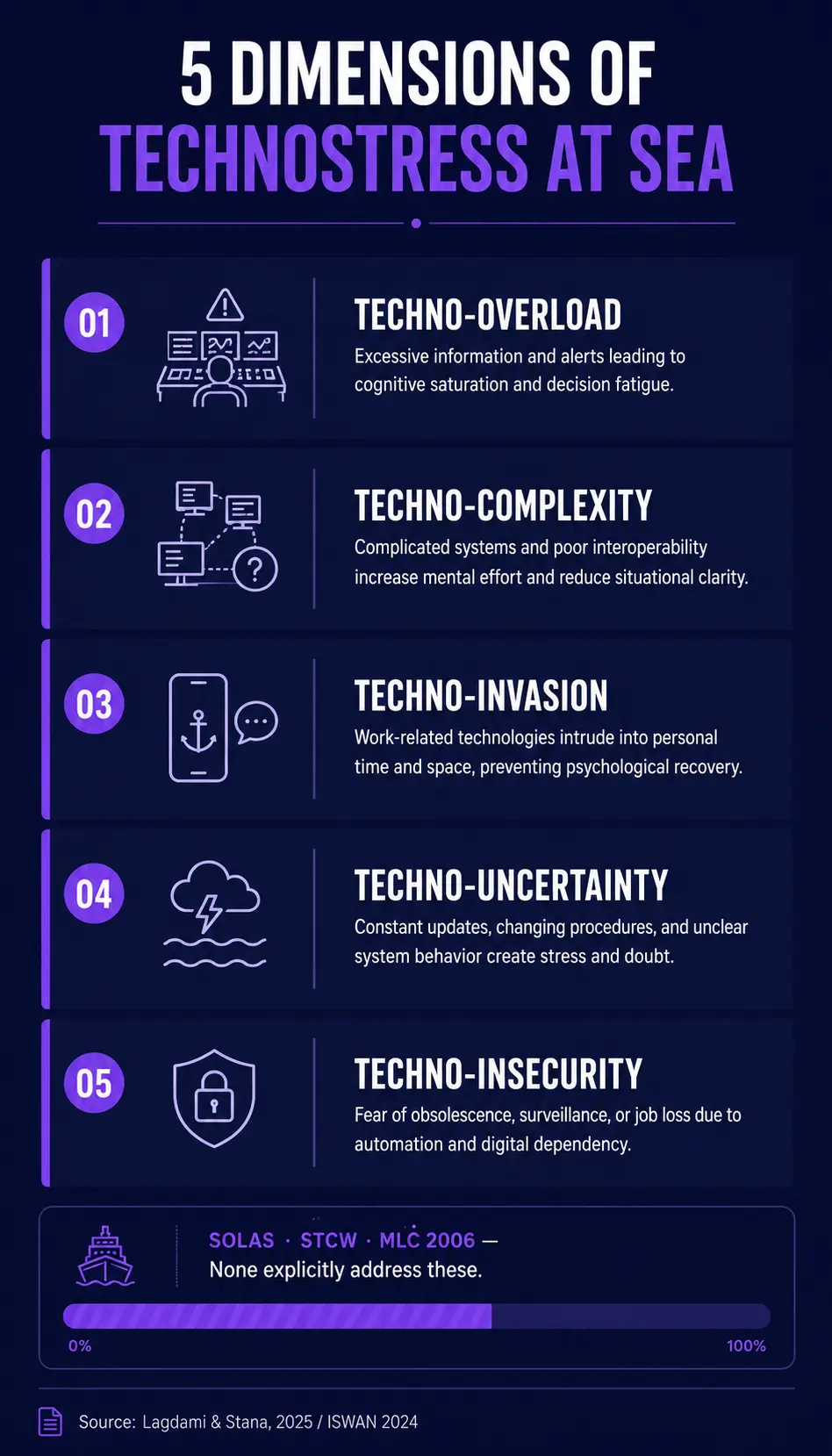
5 Dimensions of Technostress at Sea · Source: Lagdami & Stana, 2025 / ISWAN 2024 · Marine Intelligence Weekly © 2026
Why Maritime Is Uniquely Vulnerable
Technostress exists in many industries. But the maritime context amplifies it in ways that shore-based professionals rarely contend with.
- Isolation: Seafarers are cut off from the informal support networks — family, friends, colleagues, mental health services — that help land-based workers decompress.
- Hierarchical culture: The traditional command-and-control structure of ships discourages crew from openly expressing anxiety or admitting confusion about technology.
- Rapid technology turnover: Unlike a factory that installs a new machine once a decade, ships are being upgraded continuously — often with training that is cursory at best. Research confirms that crew frequently receive either very basic training or none at all when new systems are introduced.
- Decarbonisation pressure: With MARPOL regulations tightening, CII ratings being scrutinised, and the IMO's Net-Zero by 2050 strategy cascading into onboard reporting requirements, seafarers are now part of the global climate accountability chain.
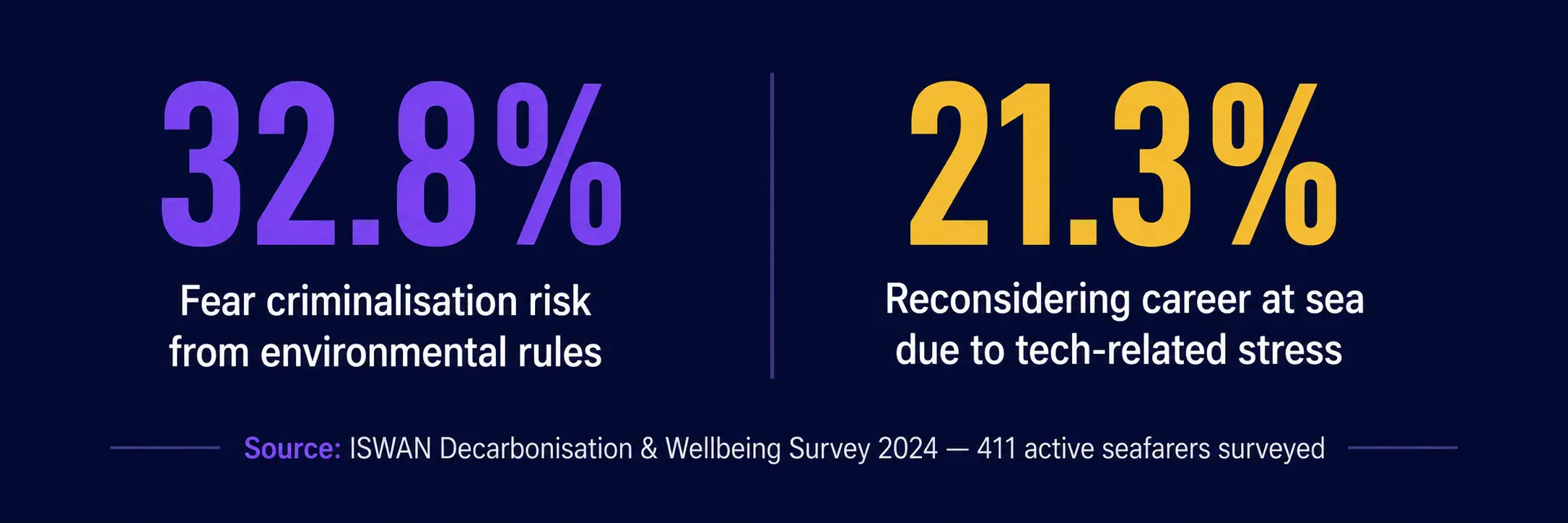
ISWAN Decarbonisation & Wellbeing Survey 2024 — 411 active seafarers surveyed · Marine Intelligence Weekly © 2026
"Without proper training, IT support, and inclusive communication structures, digitalisation risks intensifying stress rather than improving well-being. A just and human-centred transition is essential."
— Dr. Khanssa Lagdami, World Maritime University (2025)The Regulatory Blind Spot
Here lies a critical gap. Neither SOLAS, STCW, nor MLC 2006 explicitly address technostress as a defined occupational health risk. The ISM Code under SOLAS Chapter IX obliges shipowners to manage human factors within their Safety Management System (SMS), but technostress is rarely captured in risk assessments or near-miss reporting frameworks.
STCW Manila Amendments (2010) introduced basic requirements for fatigue management and mental awareness, but the convention was written in an era before integrated bridge systems and Integrated Platform Management Systems (IPMS) became standard.
As the IMO progresses its MASS regulatory framework — including the adoption of the interim MASS Code — the human element in high-automation environments demands a formal regulatory response. The current silence is not reassurance; it is a gap waiting to be filled by incident statistics.
What Ships and Companies Must Do
The solution to technostress is not to slow down digitalisation. The industry neither can nor should reverse the technological tide. But it must become far more deliberate about how change is introduced and who bears the cost of that transition.
A Practical Framework for Employers (Based on ISWAN 2024)
- Structured technology training: Not a 30-minute familiarisation walkthrough, but comprehensive, system-specific, role-appropriate training before deployment — mandated as part of the company SMS
- Crew feedback mechanisms: Actively consult seafarers during the procurement and implementation of new systems; they are the end-users, and their operational insight is invaluable
- Cohesive system design: Bridge and engine room systems that are integrated, intuitive, and reduce duplication of effort — not a patchwork of vendor-specific platforms each with its own interface logic
- Rest protection: Remote monitoring systems designed to minimise unnecessary out-of-hours intrusions, protecting the rest hours guaranteed under MLC 2006
- Mental health support: Shore-based access to counselling (ISWAN's SeafarerHelp), open-door policies for reporting digital anxiety without professional penalty
A Human Industry, Navigating an Inhuman Pace of Change
The maritime industry prides itself on its people. Seafarers are among the most resilient, adaptive, and technically capable professionals in any sector. They navigate storms, manage emergencies, and keep the arteries of global trade flowing — largely unseen and underappreciated.
But resilience is not infinite. When the pace of technological change outstrips the human capacity to absorb it — without training, without support, without acknowledgement — the result is not efficiency. It is exhaustion, disengagement, and eventually, error.
Technostress is not a complaint from crew who are resistant to change. It is a signal from professionals who are being asked to do more, with less preparation, in increasingly complex environments. The industry owes them more than a software update.
References
- Brod, C. (1984). Technostress: The Human Cost of the Computer Revolution. Addison-Wesley.
- Lagdami, K., & Stana, R. A. (2025). Technostress at sea: understanding the technological burden on seafarers' mental health. Australian Journal of Maritime & Ocean Affairs. doi.org/10.1080/18366503.2025.2554353
- Bayrak, D., & Muslu, A. (2025). The impact of digitalization on the maritime sector: Analyzing technostress among officer seafarers. Journal of International Maritime Safety, Environmental Affairs, and Shipping. doi.org/10.1080/25725084.2025.2478751
- ISWAN / Safety4Sea. (2025). The human price of progress: Seafarers and the rise of technostress. Safety4Sea
- Fleron, B. F. R., & Stana, R. A. (2024). Technostress and resistance to change in maritime digital transformation. 11th NWLC2024. arXiv:2408.17408
- Lagdami, K. (2019). Transport 2040: Impact of Technology on Seafarers. World Maritime University / ITF Seafarers' Trust.