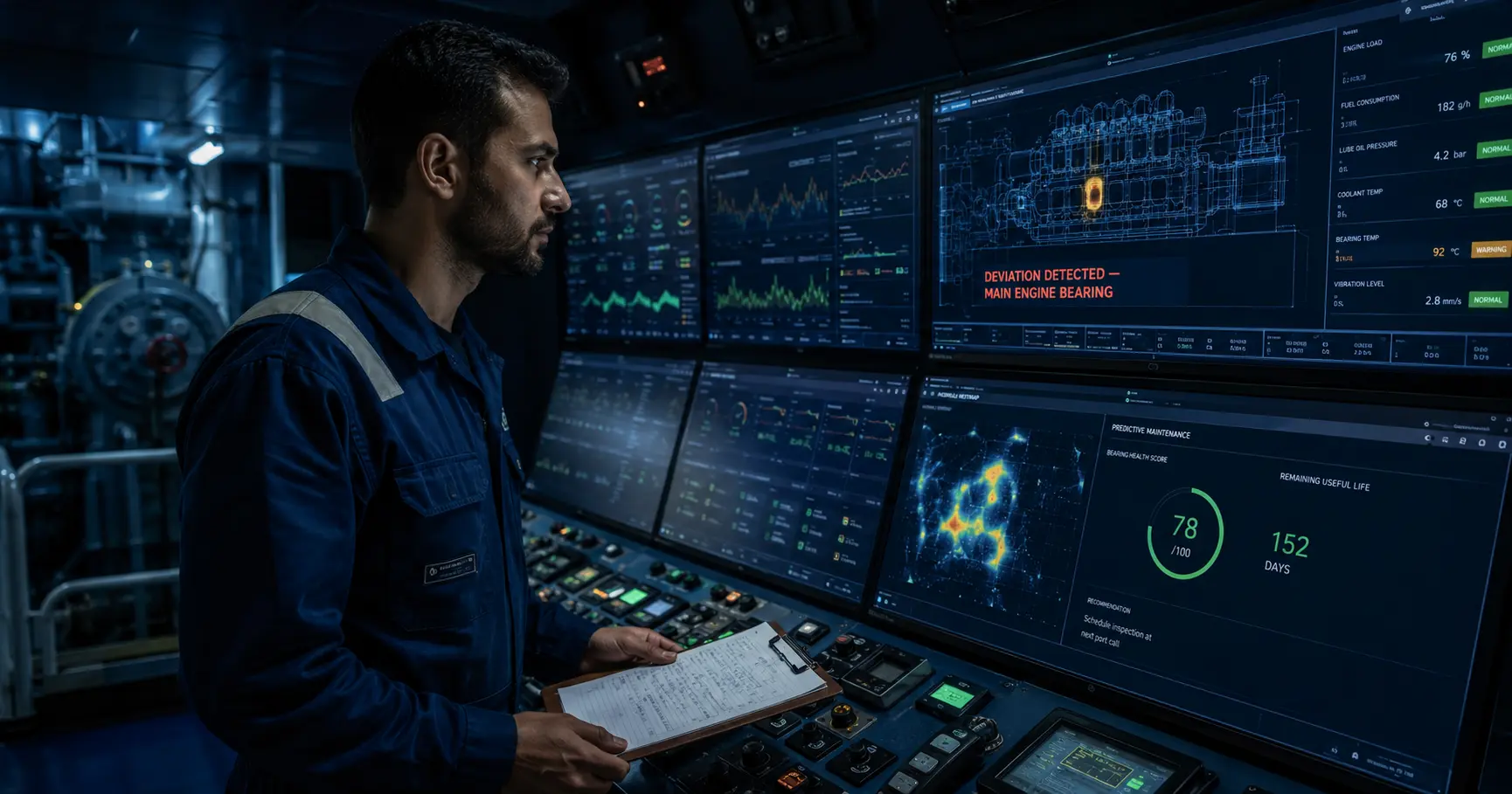
At Posidonia 2026, AI featured on almost every exhibitor stand. Predictive maintenance dashboards. Autonomous navigation trials. AI-assisted cargo planning. The message from the industry was clear: AI has arrived in shipping. The message from the engine room is more complicated.
As a Second Engineer on a Maersk container vessel and the founder of Marine Intelligence Weekly — a publication tracking AI adoption across the maritime sector — I spend time on both sides of that gap. I read the press releases. I also keep the logs. The two rarely describe the same reality.
What Is Actually Deployed
The most commercially mature maritime AI application is predictive maintenance. Platforms such as MariApps' OceanAI FaultSenseAI ingest high-frequency sensor data from main engines and auxiliary systems to detect deviation from baseline before failure.
In January 2026, Japan's GENBU container ship began regular commercial operations under Level 4-equivalent autonomous navigation — the world's first vessel carrying general cargo in commercial autonomous service. DNV's AI-embedded Steel Load Planner V2.0, launched at Posidonia 2026, automates structural load calculations within a class-approved framework. SeaGPT by Greywing automates crew change administration across 18,300 ports using GPT-4.
These are not pilots. They are commercial deployments.
"AI in maritime has moved from pilot to product. The question is no longer whether to adopt it, but whether your data is clean enough to trust it."
The Regulatory Forcing Function
AI adoption in shipping is not happening in a vacuum. The EU ETS, FuelEU Maritime, UK ETS (live from 1 July 2026), and CII collectively require data accuracy and reporting consistency that human-only systems cannot sustain at fleet scale.
MEPC 84 has shifted BWM enforcement from installation verification to performance verification — PSC will now examine UV lamp hours, flow meter calibration records, and treatment efficacy data. IACS UR E26/E27 mandates cyber resilience certificates for all essential connected systems on vessels contracted after July 2024.
The Chief Engineer's Fuel Oil Record Book entry is no longer just a MARPOL record. Under UK ETS from 1 July 2026, it feeds directly into a financial surrender calculation. Inaccurate fuel records create penalty exposure, class non-conformances, and flag state liability.
The Data Problem — Why AI Delivers Noise on Most Vessels
AI systems require clean, consistent, contextualised data. Most vessels have data living in silos — inconsistently logged, ungoverned, and not trusted by the engineers who generate it. The five gaps that most commonly break maritime AI in practice:
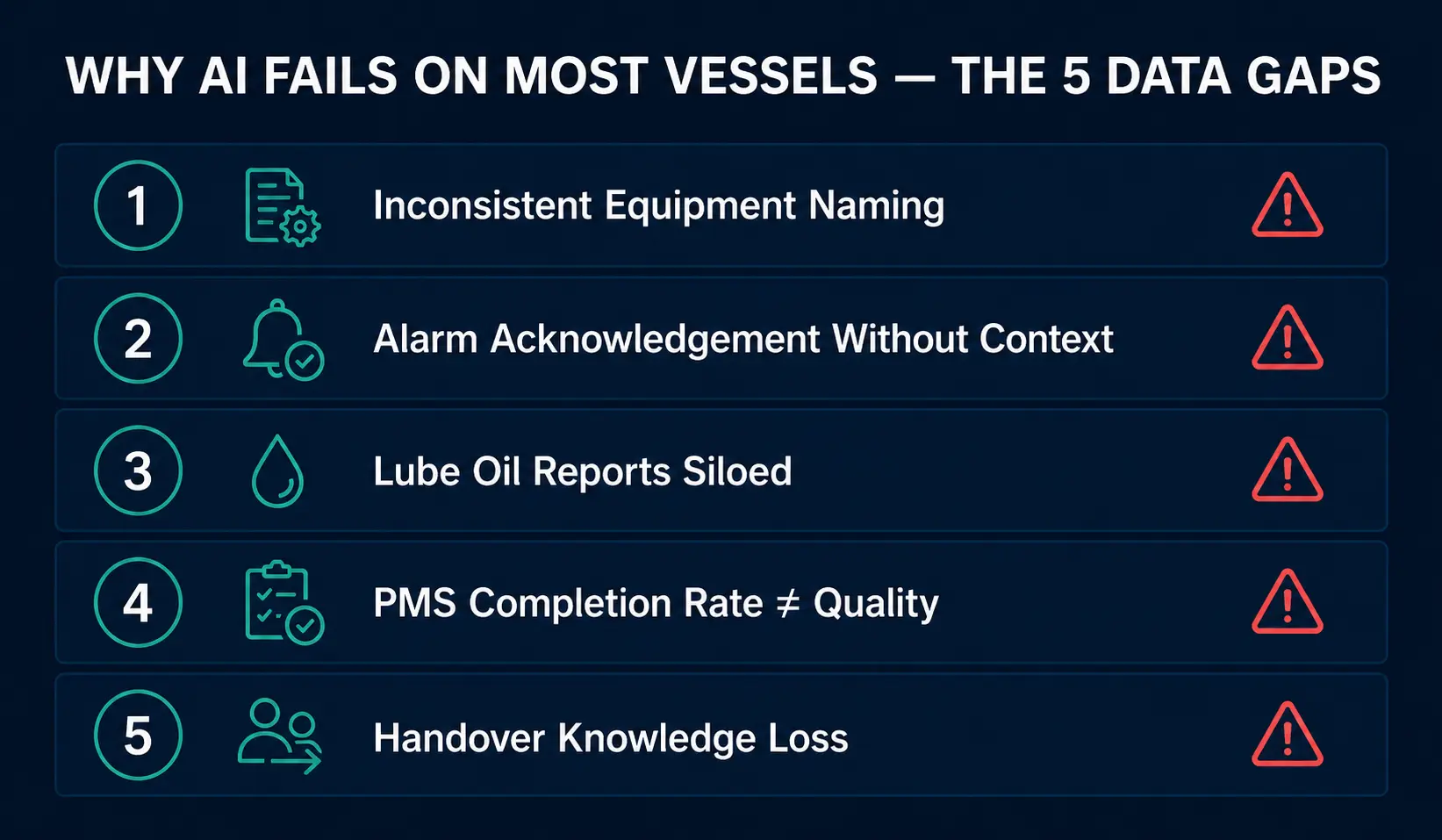
Infographic: The 5 Data Gaps that break maritime AI in practice · Marine Intelligence Weekly © 2026
- Inconsistent equipment naming across PMS, alarm systems, noon reports, and lube oil analysis — the same unit described four different ways on the same vessel
- Alarm acknowledgement without recorded context — previous false positives erode trust, alerts are cleared without investigation, developing faults advance undetected
- Lube oil analysis reports filed and forgotten — never cross-referenced against PMS completion records or alarm histories
- PMS completion rate confused with completion quality — systematically deferred items on the same system are invisible in a 95% completion dashboard
- Handover knowledge loss — the operational knowledge a Chief Engineer carries off the vessel at end of contract was never documented and cannot be learned from by any AI system
"AI fed bad data does not give insight. It gives confident-sounding noise. The data audit is the prerequisite for any AI deployment that will actually work."
What AI Still Cannot Do
The honest limit of current maritime AI is not processing power or data volume. It is reasoning. When a Chief Engineer diagnoses cascading machinery alarms during a blackout-risk scenario in heavy weather, they are combining operational context — cargo status, voyage priorities, machinery history, crew capability, regulatory exposure — into a decision under pressure, with incomplete information. No AI system currently deployed does this.
Consider a realistic scenario: a high crankcase oil mist alarm activates in Force 7 conditions. Bearing inspection is two weeks overdue. Lube oil analysis shows elevated iron. Spare shells on board are non-OEM.
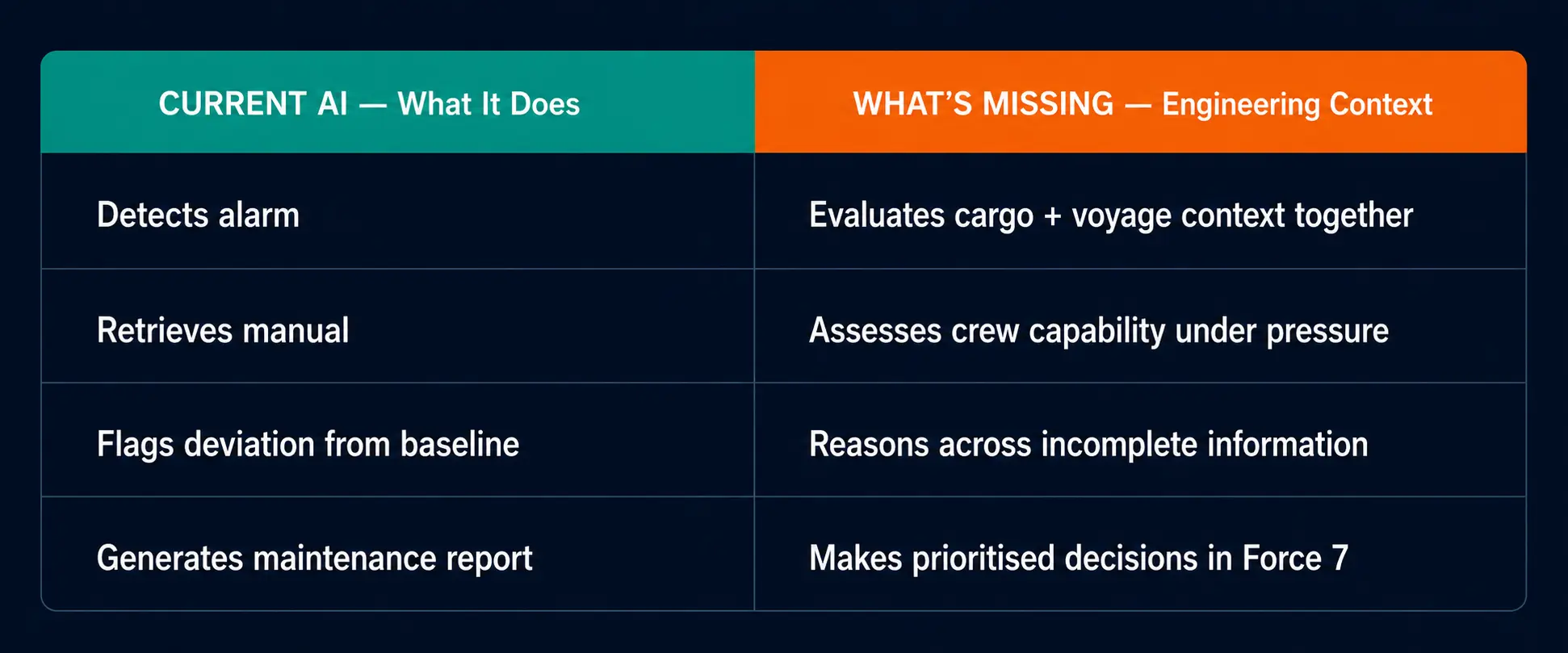
Current AI capability vs. the Engineering Context gap · Marine Intelligence Weekly © 2026
A current AI identifies the alarm and retrieves the equipment manual. A reasoning-capable system would evaluate all contextual factors simultaneously and offer a prioritised fault hypothesis with a structured investigation pathway. That capability does not yet exist commercially. Closing this gap — building what might be called an Engineering Context Protocol — is the largest untapped opportunity in maritime AI today.
What Engineers Should Do Now
The AI transition in maritime is not optional. Regulatory requirements alone are pushing every vessel toward better data management and integrated digital systems. Three immediate actions for the working engineer:
Three Actions for the Working Engineer
- Audit your data quality before AI arrives. Identify which sensor readings are trusted, where maintenance records live, and whether they cross-reference. This is the prerequisite for any AI deployment that will actually work.
- Treat the FORB as a financial document. Under UK ETS from 1 July 2026, fuel records feed surrender calculations with direct financial penalty exposure. Accuracy is no longer just a MARPOL obligation.
- Document what you know. Every quirk, sensor drift pattern, and informal workaround that lives in your head leaves the vessel when you do. Record it in PMS notes, maintenance reports, and observation logs — that is what makes a vessel's data useful to the next engineer, and eventually to an AI system.
The engineers who understand both worlds — who can manage a machinery space and read an anomaly detection output — are more valuable than either skill alone. That is the professional case for engaging with maritime AI seriously: not as a sceptic, not as a convert, but as a practitioner who knows what the technology needs to earn trust.
"AI will not replace the Chief Engineer who can diagnose a crankcase alarm in Force 7. But it will replace the one who cannot explain what data their vessel is generating, or why the pattern changed last Tuesday."